*** This version of Confluence is for testing only and contains a copy of content from June 29th 2026. No changes will be preserved. ***

...
Sometimes, systems in nature or in potential future technologies are very interesting but difficult to study with typical experimental techniques. There could be a number of reasons for this. For example, the system might be so complex that it is difficult to separate one independent variable from the rest when running an experiment. In another case, the experiment might be very difficult to carry out such that altering any one independent variable will be time intensive and costly. One approach to solving these problems is using computer modeling. Software combined with an understanding of theory can be used to build a model that describes simplified versions of interesting systems. These computer models alleviate some of the "noise" that comes from environmental effects in an experiment. Also, while experimental work might be very costly to carry out, once you have a computer, only time and knowledge is needed to properly model the system.
In the realm of electronic materials, used in applications ranging from computer chips to solar cells, modeling can be used to accomplish multiple goals. For example, software is often used to engineer and predict the performance of microscale and nanoscale electronic devices in academia and industry. This software often treats materials as a continuum, assuming that individual atoms don't need to be explicitly defined in the simulations. In addition, Ab initio, or "from first principles", calculations can be done. With these calculations, quantum phenomena are treated by solving Schrödinger's equation. This is often used to calculate mechanical and electronic properties of single molecules and crystals. Since these calculations are very intensive, some approximations need to be made because of computer memory and time limitations. Often, these approximations make it difficult to accurately capture long range electronic interactions between molecules, and accurate calculations of electronic excited states also prove to be elusive. It may be more manageable for the reader if these sentences were deleted. Is this level of detail necessary for conveying your contribution to the field?
My work is focused on modeling chemical processes that occur during the fabrication of organic electronic devices. 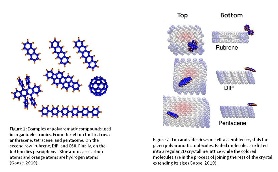 Instead of using classical semiconductors, like silicon, organic electronics use small to large polyaromatic molecules made primarily out of carbon as a semiconducting material (Figure 1). These novel electronics could be used for integrated chips, light emitting diodes, or photovoltaic devices (solar cells). Besides the fact that carbon is used, another major difference between organic and classical semiconductors is the nature of the crystals that form. While silicon atoms typically form strong covalent bonds between each other where they share electrons, organic molecules form crystals with only weak, nonbonding interactions. Unlike silicon, these forces are difficult to take into account in standard ab initio calculations, and an intricate self-assembly process is usually required to make functioning electronic devices (Figure 2). To model these systems, I use an approach called Molecular Dynamics (MD). In MD, atoms are treated as point particles following Newton's three laws of motion. Using this method, long range interactions can usually be accurately taken into account. This method can also be used to simulate many thousands of atoms over a typical time period of several nanoseconds. This amount of time is usually long enough to collect thermodynamic data like free energies and heat capacities as well as gain information on crystallization, aggregation, and diffusive processes in the materials.
...
MD can generally be a useful tool to understand the assembly process of organic electronic materials. As these materials begin to get a wider acceptance in the market (several smart phones already have organic LED displays), the opportunities to use this tool to aid in the design and engineering of organic electronics may grow. MD might be especially useful for studying organic materials used for solar cells. There, nanoscale structures involving many different organic molecules need to be assembled, and understanding these structures through experimental work alone might be difficult. It will be interesting to see where these studies lead.
Prof. Clancy's page (my advisor's page) can be found at: http://www.cheme.cornell.edu/people/profile.cfm?netid=pqc1