*** This version of Confluence is for testing only and contains a copy of content from June 29th 2026. No changes will be preserved. ***

...
My work is focused on modeling chemical processes that occur during the fabrication of organic electronic devices. 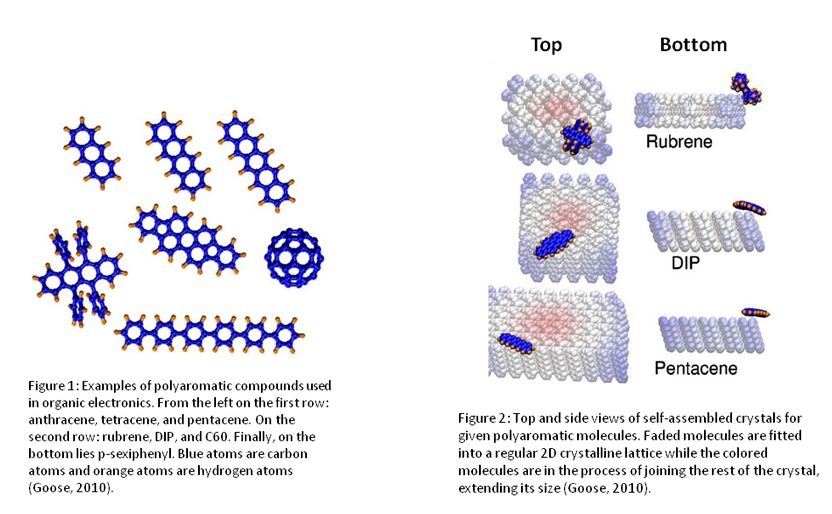
Instead of using classical semiconductors, like silicon, organic electronics use small to large polyaromatic molecules made primarily out of carbon as a semiconducting material (Figure 1). These could be used for integrated chips, light emitting diodes, or photovoltaic devices (solar cells). Besides the fact that carbon is used, another major difference between organic and classical semiconductors is the nature of the crystals that form. While silicon atoms typically form strong covalent bonds between each other where they share electrons, organic molecules form crystals with only weak, nonbonding interactions. Unlike silicon, these forces are difficult to take into account in standard ab initio calculations, and an intricate self-assembly process is usually required to make functioning electronic devices (Figure 2). To model these systems, I use an approach called Molecular Dynamics (MD). In MD, atoms are treated as point particles following Newton's three laws of motion. Using this method, long range interactions can usually be accurately taken into account. This method can also be used to simulate many thousands of atoms over a typical time period of several nanoseconds. This amount of time is usually long enough to collect thermodynamic data and gain information on crystallization, aggregation, and diffusive processes in the materials.
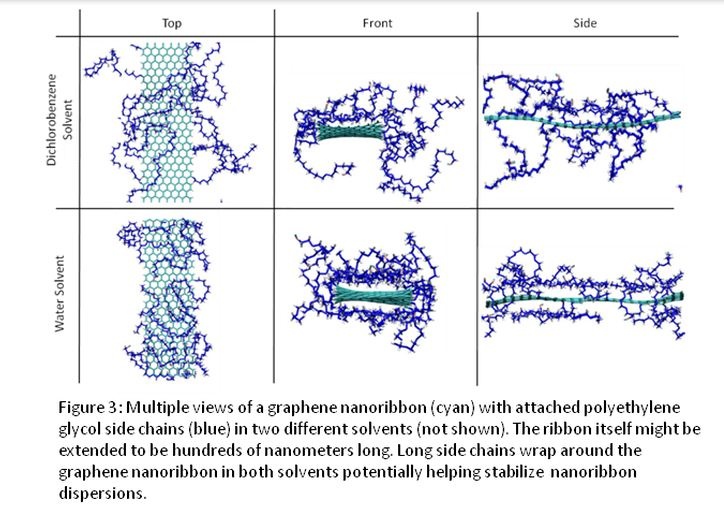
Currently, I am working with graphene nanoribbons (GNRs). Graphene is made up of a honeycomb lattice of carbon atoms and has a lot of potential to be used for electronic devices (Figure 3). GNRs are particularly interesting because they have similar band gaps to classical semiconducting materials, like silicon. The GNRs I work with are initially dispersed in solution and then assembled onto a substrate to make a carbon-based transistor. However, there are some major difficulties with this. First, graphene is really "sticky". Strong non-bonding forces between graphene sheets usually cause them to aggregate in solution into useless clumps of carbon. Also, graphene is really flexible; it has a tendency to roll up on itself, which doesn't help with the aggregation process either. With MD, we found that if long polyethylene glycol chains are attached to the sides of these ribbons, they tend to wrap around the rest of the ribbon, potentially making a type of "shield" around the GNR. In experiment, these side chains prevent the ribbons from aggregating, forming stable suspensions in solvent.
MD can generally be a useful tool to understand the assembly process of organic electronic materials. As these materials begin to get a wider acceptance in the market (several smart phones already have organic LED displays), the opportunities to use this tool to aid in the design and engineering of organic electronics may grow. MD might be especially useful on organic materials used for solar cells. There, nanoscale structures involving many different organic molecules need to be assembled, and understanding these structures through experimental work alone might be difficult. It will be interesting to see where these studies lead.
...