*** This version of Confluence is for testing only and contains a copy of content from June 29th 2026. No changes will be preserved. ***

...
The buying and selling of art typically conjures up images of an auction house, a gallery, or some other traditional brick and mortar means of transacting business. Those means still do dominate the art market in terms of transacting an enormous amount of business. Despite the recession, worldwide auction sales of art amount to a staggering $80 billion (Skates 3). Of this amount, $10 billion is sold by way of auction - three times the amount sold in 2000 (Artprice 7). Needless to say, in terms of dollars, the art market is big - very big. But even bigger, is the total sales of all goods made through over the Internet. The United States Commerce Department reported that in 2010 alone, online shoppers electronically purchased over $160 billion worth of goods (Internetretailer.com). While there is no specific published data on the amount of money spent buying art online, it comes as no surprise that a lot of people are buying and selling art by "point and click" over the internet. While transacting art online has had its ups and downs, and is not without concerns, such as authenticity, it nonetheless remains a major dynamic of the art market. In this wiki page, I will detail and analyze the business of buying and selling art online and its major players. I will also discuss the concern over authenticity (fakes / forgeries) that is an issue in the art world, particularly when it comes to buying artwork over the internet. An analysis of the tangible aspect of art and its affect on internet purchases will also be made. Finally, I will conclude this wiki by discussing and offering an answer as to whether the auction houses and galleries are doomed because of the Internet.
...
| Wiki Markup |
|---|
As long as you can afford the item, there is nothing easier than sitting down at your computer and buying something online, either by paying througha anset auctionprice or through setan priceauction. And artwork is no exception. As the New York Times reported back in June of 2011, online sales of art ("given up for dead not long ago") are now becoming "an increasingly important part of the future of the \[art business\]" (Kennedy 1). As Hans Neuendorf, CEO of Artnet.com says, more important than the increase in comfort with online commerce, is the "increase in the last decade in the number of people who spend money on contemporary art as a pastime or as an investment. They tend to see online art sales as more accessible and transparent than sales in the gallery world" (Kennedy 3). Michael Moriarity, Chairman of Skate's Art Market research, says that Internet technology "has reached a point \[where the online art\] business is really gaining traction (Kennedy 3). The nature of online art sales was verythe wellsubject described inof a 2007 Harvard Case Study of Saffronart.com, an online auction site for Indian artwork. Professor Khaire was quoted by the New York Observer: |
...
The major auction houses have an online presence (Chrisite's Live and Sotheby's BidNow) which allows registered users to bid online. While internet sales have significantly increased at both houses (ArtPrice 17), in person and live bidding at their auctions is still the focus of their business model (Montage 3). Even with as much as 28% of Christie's buyers bidding online, the average price of an online sale is "only $8,123" - compared to the global lot average of $48,900 (Montage 3). It seems that the two major auction houses, perhaps because of the Sotheby's online failure about 10 years ago, are reluctant to go full force into an online business model. I think the reason is twofold: First, the fact is that their traditional model is successful and still growing. Second, the notoriety and sensationalism of their auctions is a basic part of their branded status in the art world. Major sales from a live auction are reported on the network news – which is great (and free) publicity. Internet sales, however, do not don't even have close to the same powerful media dynamic. And while some may compare an online bid to a bid placed on the telephone, the electronic bid loses an element of reality, and possibly has some skepticism as to its validity. For instance, is the electronic bidder someone who has no intentions of buying and is only bidding to manipulate the system – kind of like a spam email that you've won a million dollars? The strategy of the auction houses with regard to online bidding simply seems to be that they'll take an online bid from a supposed qualified buyer, but they are not significantly promoting it as a means of developing their business. In other words, if their existing business model works as is, they're not going to do much to fix change it. Michael O'Neal, Senior V.P at Christie's, says that "Christie's and Sotheby's are not in direct competition with the Art Market's dot com startup ventures – they are above them" (Montage 3). So for the time being, it appears that the two major auction houses are pursuing their traditional means of live sales in the auction house, while not excluding those that want to bid online.
...
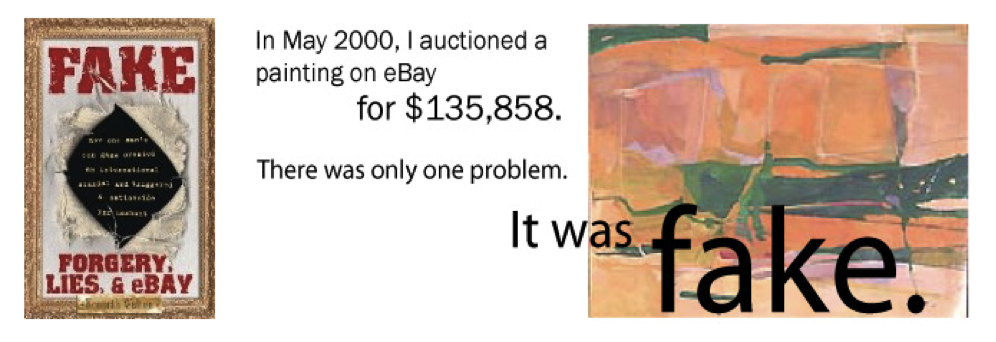
As much as the Internet has positively transformed the market place for buying and selling most anything, it has come at the price of numerous scams. With buying art online, the concern is with fakes and forgeries -- basically not knowing if what is being purchased is real or not, and what, if any, guarantee come with the purchase. Probably the most notorious case of fake art being sold on eBay is that of Ken Walton, an attorney who turned into an Internet con man. He came to the attention of the FBI when he made the front page of the New York Times after he sold a Richard Diebenkorn painting for $135,858 on ebay. The problem was that he forget forged the painter's signature. He He wrote a book about his scam titled: Fake: Forgery, Lies, and Ebay. Here is a photo of the top of his webpagewebsite, www.kennethwalton.com.
Here is an interesting YouTube interview with Walton about his sale of fake artwork on eBay.
...
The reality is that fraud in one form or another has and always will exist in the art world. Even the major auction houses have been duped tricked by scammers. It was not very long ago, that Christie's sold a fake Basquiat for over $200,000. (Artlyst 1/5/10). If a major auction house can get scammed, it can definitely happen to anyone, especially over the internet. The case of Michael Zabrin of Chicago is very telling in terms of the problems with buying and selling art online. Even though he was previously convicted of criminal theft in the past, he still was able to sell fake Picassos, Lichtensteins, and Chagalls on eBay. What was reported about the nature of his business leads me to believe that there will always be vulnerable buyers online: "When some customers realized they had bought fakes, they returned them. Zabrin acknowledged that he then waited a few months and resold them to someone else" (Artdaily.org). It's almost unbelievable how easily people can get scammed online.
eBay definitely needs to do whatever is possible to insure the authenticity of any artwork being sold, especially any expensive pieces. They should require some sort of authentication before a major item is listed, for example, a background check on the seller, the item and maybe even require an official provenance be provided before the item is listed for auction. Ebay and other online sellers of art need to instill confidence in the consumerbuyer, by most importantly, I think, offering full returns refunds in the case of a fake. All this of course is easier said then done given the nature of the Internet. The fact There is that there is no perfect remedy fix for completely fixing the problem of fraud in the art world, whether it takes place online or at the auction house. Sellers, Internet companies, dealers, etc. simply need to stand behind the authenticity of what is being sold online. And buyers need to educate themselves as much as possible and proceed with caution when it comes to buying art – especially on the internet. History has shown that a seller's positive feedback on eBay alone is not enough. Buyers need to look beyond what the website or seller says when it comes to something as complex as purchasing expensive artwork.
...
The senses are an important part of any purchase. Yet, when you buy something in cyberspace, you can't touch or feel it, or see it in person, like you would in a store or a gallery. Unless you are buying something that you have already experienced holding, like an iPod, it's hard to assess the subtleties like color and texture. Yet, "fashion," which is almost always has a touch and feel aspect about it, is a major category of eBay sales (Skates 7). With art, its tangible nature is criticalkey; the buyer needs a sense of what is being offered, which in some part I think , explains the popularity of the preview / inspection for any major auction. But the remarkable thing is that despite the difficulty in assessing the tangible nature of artwork online, the fact is that it the internet is still is a significant means of buying and selling in the art market. In fact, I I think one can say that the telephone bidder from China or Russia who doesn't, for example, attend the inspection of a Warhol or Hirst piece being auctioned off, is really no not much different than the internet buyer bidding on the same item. While it may not replace the senses involved in viewing something in person, a printed or online catalogue seems to work just fine – at least for those in the art world willing to buy without inspection. If the auction houses can sell multi-million dollar pieces of art sight unseen (or only seen in a catalogue,) then the internet should not be handicapped by an inability of the buyer to fully assess the tangible aspects of a piece of art. This is why I believe that the more advanced a web site is in terms of presenting artwork, for example, videos, high pixel digital images from different angles, etc., the less important an in-person inspection is for the buyer. Artnet's web site, with its multiple photos from different angles and zoom feature, is a good example of how the buyer can ascertain the tangible aspects of art being sold online without seeing it in person.
...
An eBay auction in cyberspace is like a football game without a live audience. Similarly, bidding on line through Sotheby's BidNow, Artnet, Christie's Live or eBay is really no different than watching a ball game from your couch. The essence of the auction is not participation by everyone in attendance; instead it is the sensationalism and marketing dynamic it gives the art market. That is not to say that online art auctions and purchases are a dying aspect of the art market. To the contrary, I think the future for the electronic art market is bright as it has been able to survive despite major obstacles and failures of some companies. The issues of authenticity and the tangible nature of art, which while important, do not seem to have significantly deterred buying art online.
While I agree with Professor Finley that the "internet has taken out some of the "fan fare of the auction experience" (wiki comment), I believe the auction houses and the galleries (especially those affiliated with branded dealers), will continue to be the standard for buying and selling art, particularly any significant works. The power of the branded auction houses and their media coverage is a key component of the success of the art market. For those that can attend the preview, it may be just as important as the auction (if not more so) in terms of being seen amongst the art market players - something that can't be done over the internet. And while going to the preview inspection may make bidding on line more comfortable, it cannot replace the auction. Yes, art can be bought and sold without a Christie's or Sotheby's. But the people in art world (and probably most all people) love the sensationalism associated with a major auction – it fuels the art market in a way that neither eBay nor any online art auction can. They also like how the star-power of a branded dealer increases prices and notoriety of artists, which in turn I think helps grow the market. So while I believe that internet art sales will expand on the internet, I don't see it significantly changing the dominance of the auction houses and galleries in the art market.
...
