*** This version of Confluence is for testing only and contains a copy of content from June 29th 2026. No changes will be preserved. ***

A great ironies irony regarding the art market and art in general is Damien Hirst. How Hirst conducts business and how the media covers him shows the art market's perpetual teeter on consumerism, and the double standard for artists and their galleries.
...
Hirst has relied on Frank Dunphy who is more than an accountant and instead acts as business manager. Dunphy has pushed galleries and dealers for margins of 70% up from the normal 50%. This business approach to art sales has pushed Hirst into borderline consumerism. Some of his most controversial pieces have had a hard time selling. His work, For the Love of God which had an initial price tag of $100 million, however was eventually bought by a syndicate which includes Hirst himself. The syndicate believes that the piece would sell at $200 million right now. 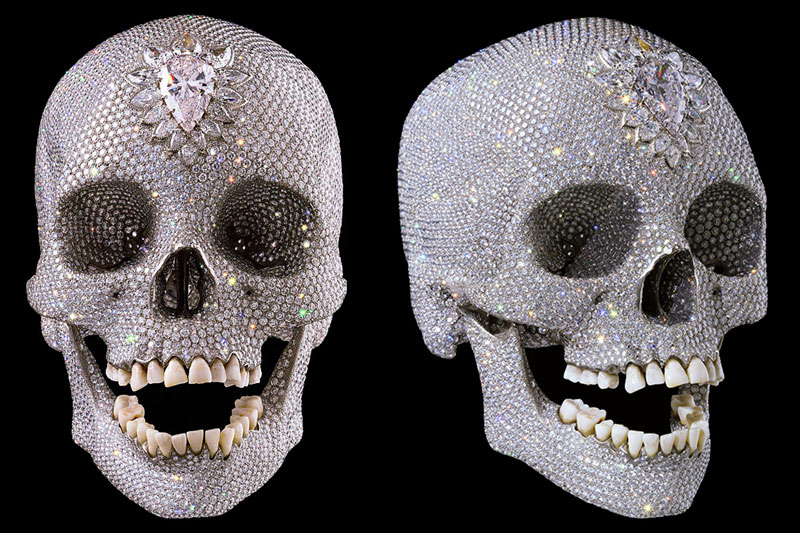
His past sales have actually fallen which lead some in the art world to believe that he has been overexposed. I find it interesting that the art world suggests that he is overexposed and not just that his art has fallen out of favor with collectors. As seen in the graph below, it is clear that the prices of his paintings have fallen greatly since his Beautiful Inside My Head Forever auction. The auction marks the end of the pre-crisis art auction period, in which the most millionaires and billionaires were able to collect art. 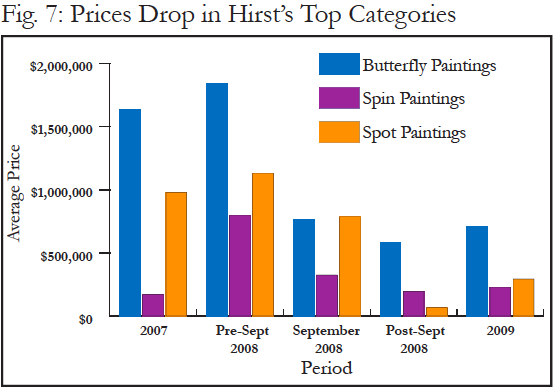
Hirst has opted for auction houses over galleries, driving up margins however pushing his art into an interesting hybrid of a normal primary market and and auction house. There are many positives to this approach. Often, galleries take a large cut, roughly 30-50% of the sale of art. By going to auction, Hirst removes the power from the dealers and gets nearly the entire gavel price at auction (buyer paying a percentage over the end auction price to the auction house). He has successfully changed the bargaining power of the modern artist, and given the people what they want now, rather than featuring his pieces in an ultra upscale gallery which is more worried about who is buying the pieces and if they will automatically go to the secondary market.
...
