*** This version of Confluence is for testing only and contains a copy of content from June 29th 2026. No changes will be preserved. ***

IntroIntroduction
Street art, known in some quarters as graffiti, experienced a proliferation in recent decades with the rise of alternative and multicultural social and political movements in the 1960s and a growing interest among socially conscious artists to increase public accessibility to art. The method goes back millennia, but we can trace its most immediate origins, perhaps, to the New Deal murals created in the 1930 and 1940s by artists employed in the Federal Art Project commissioned by the Works Progress Administration. The tradition continued in the 1960s and early 1970s, when communities of marginalized citizens, inspired by the Black Arts Movement, rallied to create public murals, such as the Chicago "Wall of Respect," produced by hundreds of African-Americans on Chicago's beleaguered South Side, using art as an instrument of collective self-empowerment and as part of a larger movement for social justice. Street art has a long history of drawing art out of the exclusive and cloistered realm of high-brow culture and into arenas where more people can participate in its creation, appreciation, and social and political ramifications. It is not surprising, of course, that what garners widespread attention is going to be susceptible to commercial exploitation. In tandem with its rise in the public profile, street art icons and symbols have been pursued and snatched up by various sectors of the advertising and retail world. At the same time, street artists have become desired entities in the aforementioned high-brow art world, their art appearing in galleries around the world, as well as in the most exclusive and profitable auction houses such as Sotheby's and Christie's. The art has also begun in recent years to enter museums – a phenomenon which has helped to raise its level of prestige and status as a respectable art form and which, consequently, has infused it with more economic value on the art market in which Sotheby's and Christie's are such major players.
...
Basquiat was, writes the Brooklyn Museum's chronologist, "avid and spontaneous" in his "picture-making, painting on canvas, paper, and found objects like refrigerators, books, and other" items. Basquiat's work demonstrated the ways in which street art could merge form and content to generate public discussion and influence the way people think about the world. His work has achieved significant success in the art world. His art goes for "seven- and eight-figure prices" in galleries in Asia, Canada, Europe, and the United States and at powerful auction houses such as Sotheby's and Christie's. It is also featured in important museums worldwide, from New York to California, Europe to Japan, Africa to Germany, Texas to Maui, from the Musee D'Art Moderne de la Ville in Paris and the Fondation Beyeler in Basel to the Brooklyn Museum and Los Angeles's MoCA. His studio and gallery exhibitions did not alter the nature of his work: "SAMO-like scrawlings reemerged in Basquiat's studio works, many of which were executed on found surfaces and thus continued to emanate a strong street art energy and immediacy" (Carter).
Click here to listen to a National Public Radio story on Basquiat.
Haring
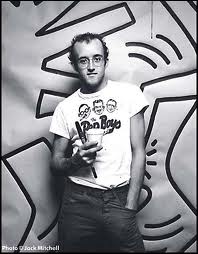
Keith Haring
The 1980s proved a boom-time for street art:
...
| Wiki Markup |
|---|
It was this experience that propelled Haring to open the [Pop Shop|http://www.pop-shop.com/drupal/?utm_source=haring&utm_medium=website&utm_campaign=haring-home] in 1986. A retail store located in New York City's [SoHo District|http://www.sohonyc.com/], the Pop Shop sold "T-shirts, toys, posters, buttons, magnets," and other paraphernalia "bearing \[Haring's\] images." Haring looked upon his shop as "an extension of his work" and his philosophy: it was "intended to allow people greater access to his work, which was now readily available on products at a low cost," explains his web site biographer. It was a place where "not only collectors could come, but also kids from the [Bronx|http://www.nyc.gov/portal/site/nycgov/menuitem.02d9ee26d69924f6a62fa24601c789a0]" ([Jade Dellinger|http://www.amazon.com/Jade-Dellinger/e/B002YRFBNS], ["Art and Commerce"|http://www.haring.com/cgi-bin/essays.cgi?essay_id=15]). The Pop Shop was subject to criticism from those in the art world who questioned whether it represented a turn toward the commercialization of art. But in that respect it was hardly different from high-end galleries and auctions -- except for the demographical constitution of the population it catered to. Haring maintained that the aesthetic quality of his work was not compromised with the opening of the Pop Shop, noting that "\[it\] was less about 'purity' and much more an issue of integrity" -- and the intention behind the Pop Shop fell comfortably in line with his sense of integrity. |
| Wiki Markup |
|---|
Of course, Haring did participate in the aforementioned high-end domain of the art world and its market. His art was and is available for extravagant prices in the most exclusive art galleries and auction houses. As Michael Gross of the _[New York Times|http://www.nytimes.com]_ noted, "Mr. Haring used to offer his art free on subway walls. Now he sells it for five-figure sums" (quoted in Dellinger). Indeed, the subway art was what made him famous and gained him critical acclaim: they were "murals-in-motion to the cognoscenti," writes Carter. But Haring continued in his conviction that all of his actions, and his resulting success in the art market, fulfilled only his objective of reaching as wide an audience as possible. He made a video for |
[MTV|http://www.mtv.com/?kw=sem/g/mtv/], created [vodka ads|http://cgi.ebay.com/1986-Keith-Haring-bottle-art-Absolut-Vodka-print-ad-/310321272416], designed [anti-drug|http://www.nycgovparks.org/parks/M208E/] and [AIDS-awareness|http://www.haring.com/foundation/about/index.html] campaigns, and sold his art in multiple galleries. Again, he encountered charges of "selling out": "Graffiti \[...has\] grown from hobby to business. Graffiti paintings are being sold in SoHo art galleries for up to $10,000 each. \[...\] Haring, who once did subway graffiti, has had major exhibitions around the world, and is critically acclaimed," r[eports Mandelit Del Barco of National Public Radio|http://www.npr.org/programs/morning/features/patc/breakdancing/article.html]. But the more successful Haring became, he maintained, the more people would be exposed to his art. The art market and commitment to social justice are not necessarily mutually exclusive but are, at times, according to theories of the "democratization of culture" ([Marcia Tucker|http://en.wikipedia.org/wiki/Marcia_Tucker] in Dellinger, ["|http://www.haring.com/cgi-bin/essays.cgi?essay_id=15]Art and Commerce"), interdependent. Haring "understood his role in merging" art and commerce as "a combination of Inc. and ink" (Dellinger, "Art and Commerce"). |
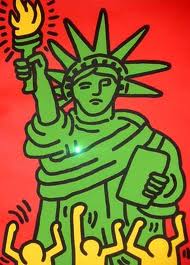
Haring's "Statue of Liberty"
...
http://www.npr.org/2011/02/22/133966402/banksys-exit-reveals-street-art-world-sort-of
http://www.lastaddress.org/haring.html
http://www.npr.org/templates/story/story.php?storyId=128744243
http://www.npr.org/programs/morning/features/patc/breakdancing/article.html
