*** This version of Confluence is for testing only and contains a copy of content from June 29th 2026. No changes will be preserved. ***

...
| Wiki Markup |
|---|
Behind the rising popularity in recent decades of street art as an effective method for artists, and as a target for galleries, dealers, and collectors are artists such as [Jean-Michel Basquiat|http://basquiat.com/] and [Keith Haring|http://www.haring.com/], who were at the "forefront" of the street art movement ([Michael Carter|http://www.gallerywalk.org/Street_Studio.html], _The Studio in the Street/The Street in the Studio_). They made celebrated, successful transitions to the established gallery scene, becoming icons seemingly overnight and, tragically, vanishing just as quickly. The fleeting quality of their lives mirrors that of street art itself, and it is precisely the ephemera of the craft that continues to draw artists. [Explains street artist Roger Gastman |http://blogs.wsj.com/speakeasy/2011/05/25/graffiti-takes-on-high-art/]in the _Wall Street Journal_: "I'd say 99 percent of the work \[in a [book|http://www.amazon.com/History-American-Graffiti-Roger-Gastman/dp/0061698784] he has compiled of graffiti art\] is not there anymore, but there will always be new work. In a way, that's part of the art." |
Basquiat
Basquiat, a black artist from a working-class family, began what became a successful career sketching images around New York City in the late 1970s under the tag name "SAMO." In his early drawings, he "transformed his own observations" about life around him "into pithy text messages inscribed on the edifices of the urban environment," according to his biographer, Fred Hoffman. This method "became the basis for his early artistic output," characterized by an effort to "distill" an idea, passion, observation, or perception "down to its core." In 1979, he began to sell "hand-painted" T-shirts and postcards, according to the Brooklyn Museum's chronology of his life.
...
Basquiat was, writes the Brooklyn Museum's chronologist, "avid and spontaneous" in his "picture-making, painting on canvas, paper, and found objects like refrigerators, books, and other" items. Basquiat's work demonstrated the ways in which street art could merge form and content to generate public discussion and influence the way people think about the world. His work has achieved significant success in the art world. His art goes for "seven- and eight-figure prices" in galleries in Asia, Canada, Europe, and the United States and at powerful auction houses such as Sotheby's and Christie's. It is also featured in important museums worldwide, from New York to California, Europe to Japan, Africa to Germany, Texas to Maui, from the Musee D'Art Moderne de la Ville in Paris and the Fondation Beyeler in Basel to the Brooklyn Museum and Los Angeles's MoCA. His studio and gallery exhibitions did not alter the nature of his work: "SAMO-like scrawlings reemerged in Basquiat's studio works, many of which were executed on found surfaces and thus continued to emanate a strong street art energy and immediacy" (Carter).
Haring
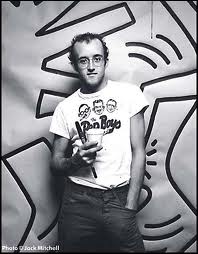
Keith Haring
The 1980s proved a boom-time for street art:
...
Elements of the stunted but fruitful career of Keith Haring, who died of AIDS in 1990, shed light on many of the issues and questions that can be raised by the relationship between street art and the art market. Haring devoted much of his life to "public works," many of which "carried social messages," according to the biography on his web site. After dropping out of commercial art school because he wanted to create art "for the people" (Haring, "Art in Transit"), he moved to New York City and began to draw "in white chalk on blank paper panels throughout the subway station," according to the biography on his web site. He created hundreds of these "public drawings," soon referred to as the "subway drawings" and consisting of "rapid rhythmic lines," between 1980 and 1985, and came to be known as the "subway artist." By 1989 Haring had "achieved international recognition and participated in numerous group and solo exhibitions," writes the web site biographer, but he continued to be concerned first and foremost with exposing broad ranges of people to art. Haring wrote:
...
The most notorious among today's emerging street artist is an anonymous tagger who travels around the world creating images under the secret identity "Banksy." He is the "man to credit for bringing street art into established gallery spaces," contend Akbar and Vallely in The Independent. "A few years ago he was sneaking his work into galleries such as the Louvre and Tate Britain. Now Tate Modern is selling his book in its gift shop. His works go for hundreds of thousands of pounds and he was recently featured in a retrospective exhibition alongside Andy Warhol. He, more than anyone else, has legitimized the genre and spawned a new generation of young imitators." Banksy has also produced an Oscar-nominated Documentary, "Exit Through the Gift Shop," and "in 2008, Sotheby's sold a painting by another artist which Banksy has defaced," reports the Wall Street Journal.
...
Click here to listen to National Public Radio's review of Banksy's documentary.
Museum Exhibitions and Gallery ShowcasesGraffiti Enters Museums and Galleries
The most recent development in street art is its entry into museums. Participation in museum exhibition confers a certain respect and prestige upon works of art that suggest an enhancement of status as recognized, quality work. The appearance of works by little-known as well as already-established artists in exhibitions such as "Street Art" at the Tate Modern in London in 2008 and "Art in the Street" at the Museum of Contemporary Art in Los Angeles (MoCA), which has already drawn thousands of viewers since its opening on June 13, 2011, underscores the rising prominence of graffiti as an accepted form of art.
...
http://www.npr.org/2011/02/22/133966402/banksys-exit-reveals-street-art-world-sort-of

