*** This version of Confluence is for testing only and contains a copy of content from June 29th 2026. No changes will be preserved. ***

...
Street art, known in some quarters as graffiti, experienced a proliferation in recent decades with the rise of alternative and multicultural social and political movements in the 1960s , 1970s subcultures like punk rock, and a growing interest among socially conscious artists to increase public accessibility to art. The method goes back millennia, but we can trace its most immediate origins, perhaps, to the New Deal murals created in the 1930 and 1940s by artists employed in the Federal Art Project commissioned by the Works Projects Progress Administration's Federal Art Project. The tradition continued in the 1960s and early 1970s, when communities of marginalized citizens, inspired by the Black Arts Movement, rallied to create public murals, such as the Chicago "Wall of Respect," created produced by hundreds of African-Americans on Chicago's beleaguered South Side, using art as an instrument of collective self-empowerment and as part of a larger movement for social justice. Street art has a long history of drawing art out of the exclusive and cloistered realm of high-brow culture and into arenas where more people can participate in its creation, appreciation, and social and political ramifications. It is not surprising, of course, that what garners widespread attention is going to be susceptible to commercial exploitation. In tandem with its rise in the public profile, street art icons and symbols have been pursued and snatched up by various sectors of the advertising and retail world. At the same time, street artists have become desired entities in the aforementioned high-brow art world, their art appearing in galleries around the world, as well as in the most exclusive and profitable auction houses such as Sotheby's and Christie's. The art has also begun in recent years to enter museums – a phenomenon which has helped to raise its level of prestige and status as a respectable art form and which, consequently, has infused it with more economic value on the art market in which Sotheby's and Christie's are such major players.
...
| Wiki Markup |
|---|
Behind the rising popularity in recent decades of street art as an effective method for artists, and as a target for galleries, dealers, and collectors are artists such as [Jean-Michel Basquiat|http://basquiat.com/] and [Keith Haring|http://www.haring.com/], who were at the "forefront" of the street art movement ([Michael Carter|http://www.gallerywalk.org/Street_Studio.html], _The Studio in the Street/The Street in the Studio_). They made celebrated, successful transitions to the established gallery scene, becoming icons seemingly overnight and, tragically, vanishing just as quickly. The fleeting quality of their lives mirrors that of street art itself, and it is precisely the ephemera of the craft that continues to draw artists. [Explains street artist Roger Gastman |http://blogs.wsj.com/speakeasy/2011/05/25/graffiti-takes-on-high-art/]in the _Wall Street Journal_: "I'd say 99 percent of the work \[in a book he has compiled of graffiti art\] is not there anymore, but there will always be new work. In a way, that's part of the art." |
BasquiatWiki Markup
Basquiat, a black artist from a working-class family, began what became a successful career sketching images around New York City in the late 1970s under the tag name ["SAMO."|http://en.wikipedia.org/wiki/SAMO©_Graffiti] In his early drawings, he "transformed his own observations" about life around him "into pithy \[...\] messages inscribed on the edifices of the urban pithy text messages inscribed on the edifices of the urban environment," according to his [biographer, Fred Hoffman|http://www.basquiat.com/artist.htm#]. This method "became the basis for his early artistic output," characterized by an effort to "distill" an idea, passion, observation, or perception "down to its core." In 1979, he began to sell "hand-painted" T-shirts and postcards, according to the [Brooklyn Museum's chronology of his life.|http://www.brooklynmuseum.org/exhibitions/basquiat/street-to-studio/english/whobasquiat.php]
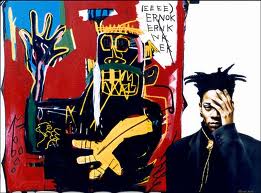
Basquiat's "Unquiet Mind"
| Wiki Markup |
|---|
"Combining elements from the [African Diaspora|http://www.niica.on.ca/diaspora/] with his own symbology," Basquiat developed "his own unique artistic style," continues the Brooklyn Museum's chronologist. Basquiat's form and "pictorial strategy," writes Hoffman, reflect concerns with "dualities" -- the personal and social/political, the spiritual and the concrete, life and death, change and stasis, as well as "wealth versus poverty, integration versus segregation, and inner versus outer experience." The themes of Basquiat's works are fitting for the medium of public art. He works out his inner dialogs in a public format, effectively bridging the divide between the internal and the external, and bringing others into the conversation in his head. Street art providesprovided him with a medium for integration in form, and the content of his art, some of which exposes the fallacies of racial segregation, for instance, supportssupported the artistic strategy. Basquiat's form paralleled the medium he employed in yet another way: His "practice of crossing out words and images," which indicated his "\[refusal\] to be identified with the limiting, transitory nature of his own life experience" (Hoffman), emulated the fleeting quality of street art itself, a theme that continues to this day to captivate the artists who practice it. |
...
