*** This version of Confluence is for testing only and contains a copy of content from June 29th 2026. No changes will be preserved. ***

...
| Wiki Markup |
|---|
Behind the rising popularity in recent decades of street art as an effective method for artists, and as a target for galleries, dealers, and collectors are artists such as [Jean-Michel Basquiat|http://basquiat.com/] and [Keith Haring|http://www.haring.com/], who were at the "forefront" of the street art movement ([Michael Carter|http://www.gallerywalk.org/Street_Studio.html], _The Studio in the Street/The Street in the Studio_). They made celebrated, successful transitions to the established gallery scene, becoming icons seemingly overnight and, tragically, vanishing just as quickly. The fleeting quality of their lives mirrors that of street art itself, and it is precisely the ephemera of the craft that continues to draw artists. [Explains street artist Roger Gastman |http://blogs.wsj.com/speakeasy/2011/05/25/graffiti-takes-on-high-art/]in the _Wall Street Journal_: "I'd say 99 percent of the work \[in a book he has compiled of graffiti art\] is not there anymore, but there will always be new work. In a way, that's part of the art." |
...
"Attracted by the wild-style energy, outlaw glamour, and public accessibility of the graffiti underground, many formally trained young artists in the early 1980s were inspired to work outside the rarified studio-gallery continuum, experimenting and 'tagging' alongside the graffitists on subway station platforms and urban wall space" (Carter).
Elements of the stunted but fruitful career of Keith Haring, who died of AIDS in 1990, shed light on many of the issues and questions that can be raised by the relationship between street art and the art market. Haring devoted much of his life to "public works," many of which "carried social messages," according to the biography on his web site. After dropping out of commercial art school because he wanted to create art "for the people" (Haring, "Art in Transit"), he moved to New York City and began to draw "in white chalk on blank paper panels throughout the subway station," according to the biography on his web site. He created hundreds of these "public drawings," soon referred to as the "subway drawings" and consisting of "rapid rhythmic lines," between 1980 and 1985, and came to be known as the "subway artist." By 1989 Haring had "achieved international recognition and participated in numerous group and solo exhibitions," writes the web site biographer, but he continued to be concerned first and foremost with exposing broad ranges of people to art. Haring wrote:
| Wiki Markup |
|---|
"I became aware of the vast differences in people's responses to the \[subway\] work. Different people saw different things in the drawings. \[...\] All kinds of people would stop and look at the huge drawing and many people were eager to comment on their feelings toward it. This was the first time I realized how many people could enjoy art if they were given the chance. These were not the people I saw in the museums or in the galleries but a cross-section of humanity that cut across all boundaries" (Haring, ["Art in Transit"|http://www.haring.com/cgi-bin/essays.cgi?essay_id=01]). |
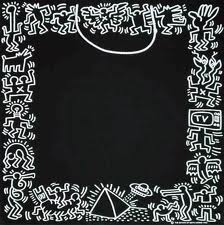
A Haring subway chalk painting
| Wiki Markup |
|---|
It was this experience that propelled Haring to open the [Pop Shop|http://www.pop-shop.com/drupal/?utm_source=haring&utm_medium=website&utm_campaign=haring-home] in 1986. A retail store located in New York City's [SoHo District|http://www.sohonyc.com/], the Pop Shop sold "T-shirts, toys, posters, buttons, magnets," and other paraphernalia "bearing \[Haring's\] images." Haring looked upon his shop as "an extension of his work" and his philosophy: it was "intended to allow people greater access to his work, which was now readily available on products at a low cost," explains his web site biographer. It was a place where "not only collectors could come, but also kids from the Bronx" ([Jade Dellinger|http://www.amazon.com/Jade-Dellinger/e/B002YRFBNS], ["Art and Commerce"|http://www.haring.com/cgi-bin/essays.cgi?essay_id=15]). The Pop Shop was subject to criticism from those in the art world who questioned whether it represented a turn toward the commercialization of art. But in that respect it was hardly different from high-end galleries and auctions -- except for the demographical constitution of the population it catered to. Haring maintained that the aesthetic quality of his work was not compromised with the opening of the Pop Shop, noting that "\[it\] was less about 'purity' and much more an issue of integrity" -- and the intention behind the Pop Shop fell comfortably in line with his sense of integrity. |
Of course, Haring did participate in the aforementioned high-end domain of the art world and its market. His art was and is available for extravagant prices in the most exclusive art galleries and auction houses. As Michael Gross of the New York Times noted, "Mr. Haring used to offer his art free on subway walls. Now he sells it for five-figure sums" (quoted in Dellinger). Indeed, the subway art was what made him famous and gained him critical acclaim: they were "murals-in-motion to the cognoscenti," writes Carter. But Haring continued in his conviction that all of his actions, and his resulting success in the art market, fulfilled only his objective of reaching as wide an audience as possible. He made a video for MTV, created vodka ads, designed anti-drug and AIDS-awareness campaigns, and sold his art in multiple galleries. But the more successful he became, he maintained, the more people would be exposed to his art. The art market and commitment to social justice are not necessarily mutually exclusive but are, at times, according to theories of the "democratization of culture" (Marcia Tucker in Dellinger, "Art and Commerce"), interdependent. Haring "understood his role in merging" art and commerce as "a combination of Inc. and ink" (Dellinger, "Art and Commerce").
...
Basquiat and Haring established a tradition of street art that many young artists sought to emulate. Writes Carter, "In their wake, somewhat younger artists, edgy and ambitious, saw the streets as their studio, especially in the East Village." They "took painterly cues from" Basquiat and Haring. These artists include the likes of Barry McGee, Swoon, Blek Le Rat, D*Face|www.dface.co.uk/|\, , Judith Supine, Elbowtoe, Stickman, Retna, War Boutique, Kenichi (Ken) Hiratsuka, Brian Gormley, Scot Borofsky, Shepard Fairey, Faile, Blu, the Os Gemeos brothers, and Roger Gastman. Collectively they have by now gained the street art genre something close to mainstream acceptance.
...
The most notorious among today's emerging street artist is an anonymous tagger who travels around the world creating images under the secret identity "Banksy." He is the "man to credit for bringing street art into established gallery spaces," contend Akbar and Vallely in The Independent. "A few years ago he was sneaking his work into galleries such as the Louvre and Tate Britain. Now Tate Modern is selling his book in its gift shop. His works go for hundreds of thousands of pounds and he was recently featured in a retrospective exhibition alongside Andy Warhol. He, more than anyone else, has legitimized the genre and spawned a new generation of young imitators." Banksy has also produced an Oscar-nominated Documentary, "Exit Through the Gift Shop," and "in 2008, Sotheby's sold a painting by another artist which Banksy has defaced," reports the Wall Street Journal. 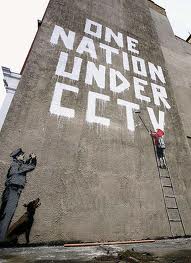
By Banksy
Museum Exhibitions and Gallery Shows
...
http://artiseverywhere.wordpress.com/2009/02/04/street-art-and-museums-what-happens-after-they-meet/
http://www.nycgovparks.org/parks/M208E/
http://www.haring.com/foundation/about/index.html
http://www.brooklynstreetart.com/theblog/
