*** This version of Confluence is for testing only and contains a copy of content from June 29th 2026. No changes will be preserved. ***

...
Street art, known in some quarters as graffiti, experienced a proliferation in recent decades with the rise of alternative and multicultural social and political movements in the 1960s, 1970s subcultures like punk rock, and a growing interest among socially conscious artists to increase public accessibility to art. The method goes back millennia, but we can trace its most immediate origins, perhaps, to the New Deal murals created in the 1930 and 1940s by artists employed in the Works Projects Administration's Federal Art Project. The tradition continued in the 1960s and early 1970s, when communities of marginalized citizens, inspired by the Black Arts Movement, rallied to create public murals, such as the Chicago "Wall of Respect," created by hundreds of African Americans on Chicago's beleaguered South Side, using art as an instrument of collective self-empowerment and as part of a larger movement for social justice. Street art has a long history of drawing art out of the exclusive and cloistered realm of high-brow culture and into arenas where more people can participate in its creation, appreciation, and social and political ramifications. It is not surprising, of course, that what garners widespread attention is going to be susceptible to commercial exploitation. In tandem with its rise in the public profile, street art icons and symbols have been pursued and snatched up by various sectors of the advertising and retail world. At the same time, street artists have become desired entities in the aforementioned high-brow art world, their art appearing in galleries around the world, as well as in the most exclusive and profitable auction houses such as Sotheby's and Christie's. The art has also begun in recent years to enter museums – a phenomenon which has helped to raise its level of prestige and status as a respectable art form and which, consequently, has infused it with more economic value on the art market in which Sotheby's and Christie's are such major players.
...
| Wiki Markup |
|---|
In 1935, [Franklin Delano Roosevelt|http://en.wikipedia.org/wiki/Franklin_D._Roosevelt] established the Works Progress Administration (WPA) "to help provide economic relief" from the [Great Depression|http://www.english.illinois.edu/maps/depression/about.htm], according to the [WPA Murals web site.|http://www.wpamurals.com/] Inspired by [Mexican muralists'|http://www.tate.org.uk/collections/glossary/definition.jsp?entryId=165] "revitalization of the [Italian Renaissance |http://www.ibiblio.org/wm/paint/tl/it-ren/] fresco style" in the 1920s and 1930s, the intention was to harness "the creativity of the new art movements" to create jobs for more Americans. This endeavor, executed by the Federal Art Project, resulted in "5,000 jobs for artists and \[...\] over 225,000 works of art for the American people. |
...
| Wiki Markup |
|---|
Basquiat, a black artist from a working-class family, began what became a successful career sketching images around New York City in the late 1970s under the tag name ["SAMO."|http://en.wikipedia.org/wiki/SAMO©_Graffiti] In his early drawings, he "transformed his own observations" about life around him "into pithy \[...\] messages inscribed on the edifices of the urban environment," according to his [biographer, Fred Hoffman|http://www.basquiat.com/artist.htm#]. This method "became the basis for his early artistic output," characterized by an effort to "distill" an idea, passion, observation, or perception "down to its core." In 1979, he began to sell "hand-painted" T-shirts and postcards, according to the [Brooklyn Museum's chronology of his life.|http://www.brooklynmuseum.org/exhibitions/basquiat/street-to-studio/english/whobasquiat.php] |
...
| Wiki Markup |
|---|
"Combining elements from the [African Diaspora|http://www.niica.on.ca/diaspora/] with his own symbology," Basquiat developed "his own unique artistic style," continues the Brooklyn Museum's chronologist. Basquiat's form and "pictorial strategy," writes Hoffman, reflect concerns with "dualities" -- the personal and social/political, the spiritual and the concrete, life and death, change and stasis, as well as "wealth versus poverty, integration versus segregation, and inner versus outer experience." The themes of Basquiat's works are fitting for the medium of public art. He works out his inner dialogs in a public format, effectively bridging the divide between the internal and the external, and bringing others into the conversation in his head. Street art provides him with a medium for integration in form, and the content of his art, some of which exposes the fallacies of racial segregation, for instance, supports the artistic strategy. Basquiat's form paralleled the medium he employed in yet another way: His "practice of crossing out words and images," which indicated his "\[refusal\] to be identified with the limiting, transitory nature of his own life experience" (Hoffman), emulated the fleeting quality of street art itself, a theme that continues to this day to captivate the artists who practice it. |
...
Basquiat and Haring established a tradition of street art that many young artists sought to emulate. Writes Carter, "In their wake, somewhat younger artists, edgy and ambitious, saw the streets as their studio, especially in the East Village." They "took painterly cues from" Basquiat and Haring. These artists include the likes of Barry McGee, Swoon, Blek Le Rat,D*Face|www.dface.co.uk/|\, Judith Supine, Elbowtoe, Stickman, Retna, War Boutique, Kenichi (Ken) Hiratsuka, Brian Gormley, Scot Borofsky, Shepard Fairey, Faile, Blu, the Os Gemeos brothers, and Roger Gastman. Collectively they have by now gained the street art genre something close to mainstream acceptance.
...
| Wiki Markup |
|---|
Those women have "made it" resent being defined by their gender; they view themselves as artists, not "female taggers." Swoon, who found in the graffiti genre a means to assert her "\[independence\] from the ideologies of institutional art," chose an alias with "no feminine connotations" precisely for this reason. But with her emerging prominence in the art world, she was recognized as female, and the resulting "attention \[...\] left her feeling alienated and objectified. \[...\] I never want to make anything that could be pigeonholed as 'women's work.' I'm way too interested in the human experience," she [explains|http://student.dcu.ie/~delanea7/ExtremeUrbanWoman/articles/graffiti.html]. |

By Swoon
| Wiki Markup |
|---|
[Nicholas Ganz|http://www.lightstalkers.org/nicholas_ganz], a photographer who has chronicled the world of street art, wrotecompiled a book called _[Graffiti Women._ He [contends|http://www.formatmagamazon.com/features/nicholas-ganz/Graffiti-Women-Street-Five-Continents/dp/0810957477]__._ He [contends|http://www.formatmag.com/features/nicholas-ganz/] that the "movement is actually not \[as\] male dominated as people think." The problem is that women in graffiti aren't garnering the sort of recognition that male graffiti artists have received. It is true: While women street artists such as [Lady Fever|http://www.ladykfever.com/] (who has fashioned her artistic identity after Lady Pink) and [Girls On Top|http://www.britishhiphop.co.uk/news/latest/frisson_gallery_girls_on_top_exhibition.html], a female graffiti artist collaborative, have shown their work in multiple exhibitions, they are harder to find. Perhaps the media is just not paying enough attention. |
...
The most notorious among today's emerging street artist is an anonymous tagger who travels around the world creating images under the secret identity "Banksy." He is the "man to credit for bringing street art into established gallery spaces," contend Akbar and Vallely in The Independent. "A few years ago he was sneaking his work into galleries such as the Louvre and Tate Britain. Now Tate Modern is selling his book in its gift shop. His works go for hundreds of thousands of pounds and he was recently featured in a retrospective exhibition alongside Andy Warhol. He, more than anyone else, has legitimized the genre and spawned a new generation of young imitators." Banksy has also produced an Oscar-nominated Documentary, "Exit Through the Gift Shop," and "in 2008, Sotheby's sold a painting by another artist which Banksy has defaced," reports the Wall Street Journal. 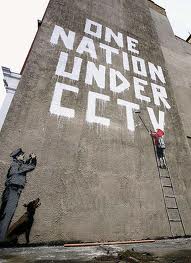
By Banksy
Museum Exhibitions and Gallery Shows
...
Three years later, the debate continues. The opening of the MoCA exhibition "Art in the Streets," which runs through August 8, has spawned both a flurry of graffiti art in the area and a concomitant crackdown by law enforcement, reports the Wall Street Journal. Retna, an artist whose work is featured in the exhibit and who calls himself a "graffiti writer" and mural artist – specifically not a "street artist" – told me in a phone interview on Wednesday, points out that the "negative press" generated by the entry of street and graffiti art into museums and galleries, much of it the result of the reality that the "art" is also a crime, suggests that we can't look to this development as undiluted evidence that street art has entered the arena of respectability. True, Retna concedes, he and other graffiti writers have achieved success in establishments within the art market and the art world – he shows in galleries and museums in Hong Kong, Miami, New York City, London, and Los Angeles. But "for every ten new supporters, we still gain new people against it. Publicity goes both ways."
...
http://www.formatmag.com/features/nicholas-ganz/
http://www.digitalretna.com/blog/2011/02/hallelujah-graffiti-artist-retna-goes-global/
http://www.tate.org.uk/collections/glossary/definition.jsp?entryId=165
http://en.wikipedia.org/wiki/SAMO©_Graffiti
http://artiseverywhere.wordpress.com/2009/02/04/street-art-and-museums-what-happens-after-they-meet/
