*** This version of Confluence is for testing only and contains a copy of content from June 29th 2026. No changes will be preserved. ***

...
| Wiki Markup |
|---|
Behind the rising popularity in recent decades of street art as an effective method for artists, and as a target for galleries, dealers, and collectors are artists such as [Jean-Michel Basquiat|http://basquiat.com/] and [Keith Haring|http://www.haring.com/], who were at the "forefront" of the street art movement ([Michael Carter|http://www.gallerywalk.org/Street_Studio.html], _The Studio in the Street/The Street in the Studio_). They made celebrated, successful transitions to the established gallery scene, becoming icons seemingly overnight and, tragically, vanishing just as quickly. The fleeting quality of their lives mirrors that of street art itself, and it is precisely the ephemera of the craft that continues to draw artists. [Explains street artist Roger Gastman |http://blogs.wsj.com/speakeasy/2011/05/25/graffiti-takes-on-high-art/]in the _Wall Street Journal_: "I'd say 99 percent of the work \[in a [book|http://www.amazon.com/History-American-Graffiti-Roger-Gastman/dp/0061698784] he has compiled of graffiti art\] is not there anymore, but there will always be new work. In a way, that's part of the art." |
Basquiat
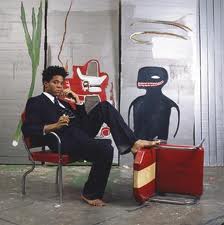
Basquiat
Basquiat, a black artist from a working-class family, began what became a successful career sketching images around New York City in the late 1970s under the tag name "SAMO." In his early drawings, he "transformed his own observations" about life around him "into pithy text messages inscribed on the edifices of the urban environment," according to his biographer, Fred Hoffman. This method "became the basis for his early artistic output," characterized by an effort to "distill" an idea, passion, observation, or perception "down to its core." In 1979, he began to sell "hand-painted" T-shirts and postcards, according to the Brooklyn Museum's chronology of his life.
...
Basquiat was, writes the Brooklyn Museum's chronologist, "avid and spontaneous" in his "picture-making, painting on canvas, paper, and found objects like refrigerators, books, and other" items. Basquiat's work demonstrated the ways in which street art could merge form and content to generate public discussion and influence the way people think about the world. His work has achieved significant success in the art world. His art goes for "seven- and eight-figure prices" in galleries in Asia, Canada, Europe, and the United States and at powerful auction houses such as Sotheby's and Christie's. It is also featured in important museums worldwide, from New York to California, Europe to Japan, Africa to Germany, Texas to Maui, from the Musee D'Art Moderne de la Ville in Paris and the Fondation Beyeler in Basel to the Brooklyn Museum and Los Angeles's MoCA. His studio and gallery exhibitions did not alter the nature of his work: "SAMO-like scrawlings reemerged in Basquiat's studio works, many of which were executed on found surfaces and thus continued to emanate a strong street art energy and immediacy" (Carter).
More by Basquiat, typical of his iconographic style:
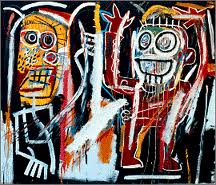
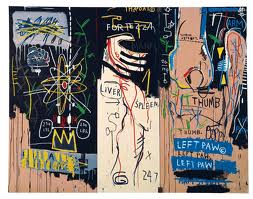
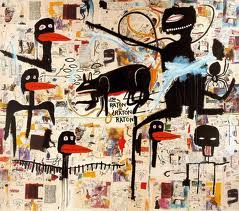
Click here to listen to a National Public Radio story on Basquiat.
...
| Wiki Markup |
|---|
"I became aware of the vast differences in people's responses to the \[subway\] work. Different people saw different things in the drawings. \[...\] All kinds of people would stop and look at the huge drawing and many people were eager to comment on their feelings toward it. This was the first time I realized how many people could enjoy art if they were given the chance. These were not the people I saw in the museums or in the galleries but a cross-section of humanity that cut across all boundaries" (Haring, "Art in Transit"). |
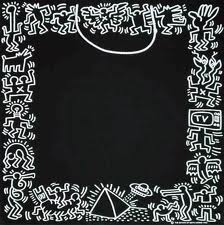
An example Examples of Haring's chalk drawings:
| Wiki Markup |
|---|
!haring chalk.jpeg|border=1!
!more haring.jpeg|border=1!
It was this experience that propelled Haring to open the [Pop Shop|http://www.pop-shop.com/drupal/?utm_source=haring&utm_medium=website&utm_campaign=haring-home] in 1986. A retail store located in New York City's [SoHo District|http://www.sohonyc.com/], the Pop Shop sold "T-shirts, toys, posters, buttons, magnets," and other paraphernalia "bearing \[Haring's\] images." Haring looked upon his shop as "an extension of his work" and his philosophy: it was "intended to allow people greater access to his work, which was now readily available on products at a low cost," explains his web site biographer. It was a place where "not only collectors could come, but also kids from the [Bronx|http://www.nyc.gov/portal/site/nycgov/menuitem.02d9ee26d69924f6a62fa24601c789a0]" ([Jade Dellinger|http://www.amazon.com/Jade-Dellinger/e/B002YRFBNS], ["Art and Commerce"|http://www.haring.com/cgi-bin/essays.cgi?essay_id=15]). The Pop Shop was subject to criticism from those in the art world who questioned whether it represented a turn toward the commercialization of art. But in that respect it was hardly different from high-end galleries and auctions -- except for the demographical constitution of the population it catered to. Haring maintained that the aesthetic quality of his work was not compromised with the opening of the Pop Shop, noting that "\[it\] was less about 'purity' and much more an issue of integrity" -- and the intention behind the Pop Shop fell comfortably in line with his sense of integrity. |
...
