*** This version of Confluence is for testing only and contains a copy of content from June 29th 2026. No changes will be preserved. ***

...
Disaffected minorities in the 1960s picked up on the idea of using art to promote social justice. During the Black Arts Movement of the 1960s, which witnessed a flurry of art production by African-American artists, predominantly-black communities in economically-destitute areas convened in grassroots movements to create public murals in acts of "guerrilla art" designed to challenge conventional ideas about ownership and rights. Chicago's "Wall of Respect," sponsored by the Organization of Black American Culture (OBAC), was produced in 1969 by hundreds of black citizens and featuring featured a spread of African-American heroes. The collective, communal process of creating the mural infused the South Side community with a sense of morale and empowerment at the same time that it promoted political activism on behalf of civil rights. The very act of creating the mural was process amounted to a reclamation of black identity and culture, both through the content involved -- black heroes -- and in the collective nature of the act, a process that connected those involved with their historical cultural value for community. And the physical act, too, represented a reclamation, a taking-back of private property for collective use. It was also, as graffiti tends to be, an act of defiance, a "defacing" of property for a greater good, a conversion of that property into something more beautiful. Although Although the public works of the 1930s and 1940s under the New Deal were commissioned by the government and thus far from illegal, the principles undergirding their production were similar to those that fueled the creation of Black Arts Movement murals: the use of art to transform people's lives in a highly public manner.
...
Click here to view a video called "Ghost of the Walls," produced in homage to the murals created during the Black Arts Movement.
Click here or more information on black arts.
Street Art, the 1970s and Beyond
...
Click here to view Basquiat's exhibitions at the Whitney in New York City.
Click here for links to Basquiat's world-wide exhibitions.
Haring
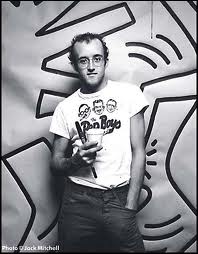
Keith Haring
The 1980s proved a boom-time for street art:
...
http://www.blackartsinteractive.com/featured-organization
http://www.art.howard.edu/africobra-sparking-revolutionary-trends-in-culture/
http://www.youtube.com/watch?v=NbxWVblT4ss
...
http://www.brooklynmuseum.org/exhibitions/basquiat/street-to-studio/english/whobasquiat.php
http://www.basquiatbiography.com/basquiat-exhibitions
http://en.wikipedia.org/wiki/SAMO©_Graffiti
...
http://www.haring.com/foundation/about/index.html
http://www.artnet.com/artists/keith-haring/art-exhibitions
http://www.artsjournal.com/artopia/2008/05/keith_haring_redux.html
http://hyperallergic.com/27249/david-lachapelle-lecture/
http://subwayartblog.com/tag/keith-haring/
...
http://www.npr.org/programs/morning/features/patc/breakdancing/article.html
http://hyperallergic.com/3415/street-art-politics-commercialization/
