*** This version of Confluence is for testing only and contains a copy of content from June 29th 2026. No changes will be preserved. ***

...
The design challenge for the 2010 Spring AguaClara Filtration Team is to design a filtration system for the AguaClara water treatment plant. The filtration system must meet the following requirements: reliably treat the current AguaClara effluent water with a turbidity ranging from 5 to 10 NTU producing to an effluent turbidity less than 1 NTU, not require any electricity, make minimal use of specialized components that would be difficult to acquire in remote communities, and the system should be easy to construct and to maintain.
Currently, the filtration team has conducted research in four fields: stacked filtration, clear well backwash, foam filtration, and siphon-aided backwash. For each subject, we conducted a literature review of existing technology and research. We then developed initial designs based on our research and proceeded to test the fundamental theories behind our design. For example, the foam filtration sub team tested the effectiveness of foam in reducing the turbidity of the water while the clear well backwash team developed a bench scale model to test the empirical equations behind the design. We have currently ruled out further research in clear well and siphon-aided backwash design for economic reasons. Table 1 Filtration Design Tracker summarizes our current progress in filtration research.
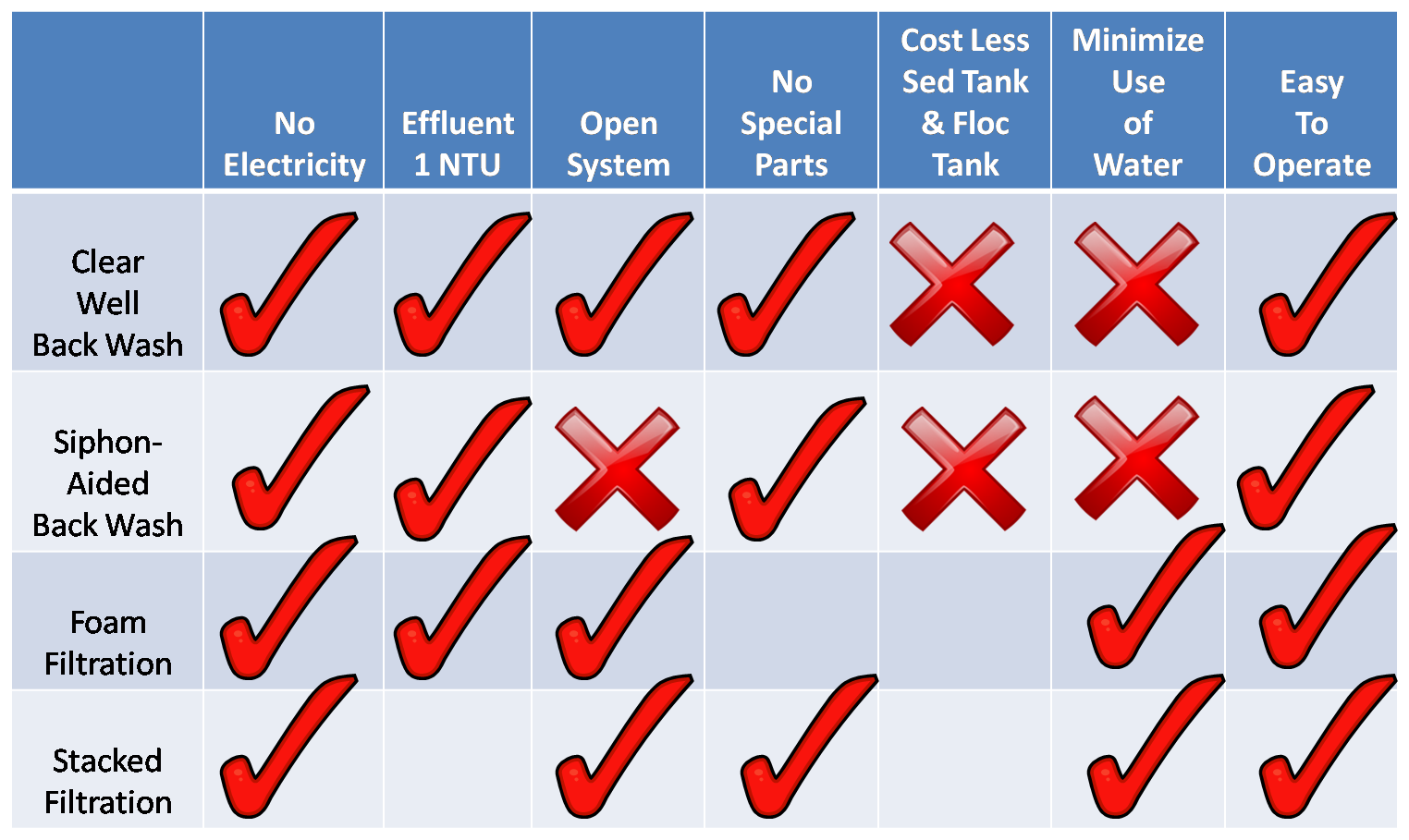
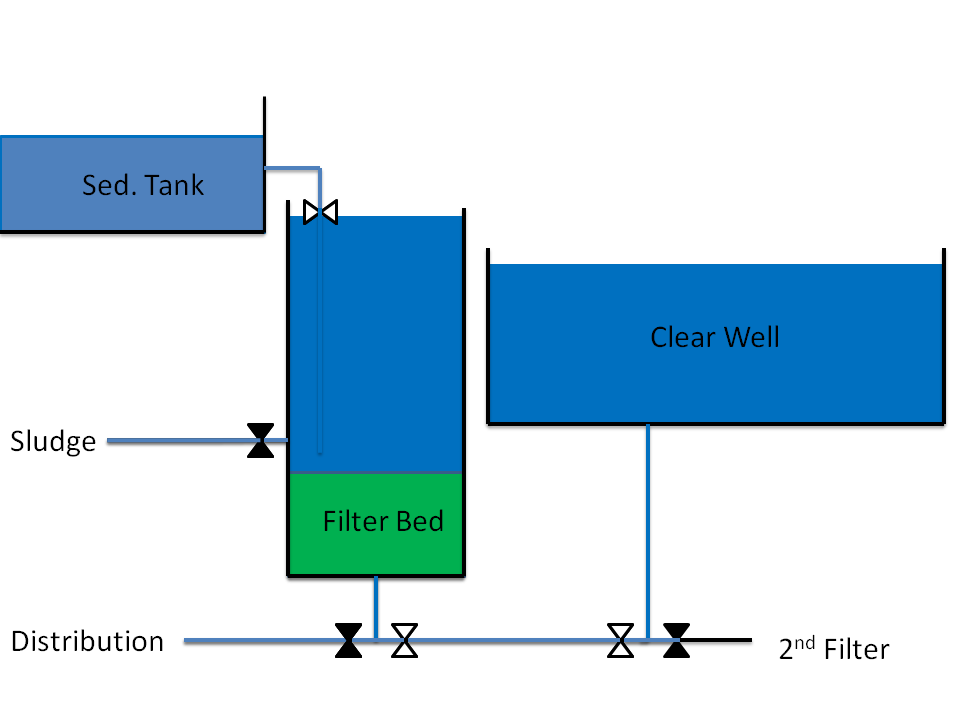
Table 1 Filtration Design Tracker
...
• The operator needs to be able to observe the backwash process, so the filter media must be visible. This is likely to be impossible with pressure filters.
• The improvement in water quality from filtration is perceived by the community to be small compared to the improvement from the flocculation and sedimentation processes, so the filters need to be less expensive than the flocculation and sedimentation equipment.
• A large tank to hold water for backwashing is not economically feasible.
• The distribution tank is not a viable source of water for backwashing because it is impossible to guarantee that there will be enough water in the distribution tank.
• Many of the communities that will be using our water treatment plants do not have enough water to meet their needs, so the quantity of water that is wasted to clean the filters must be minimized. Stacked filtration and foam filtration may be good options for achieving this.
• If we can't use stored water for backwash, then the maximum flow of water required for backwash must be at most 50% of the design plant flow rate. This will make it possible to run the water treatment plant at a lower than design flow rate and still be able to operate the filters. This requirement means that if we use 7 filters to backwash 1 filter, that then we would need to have another set of 8 filters that could potentially be turned off so that plant could function at 50% of design flow capacity. The requirement of being able to backwash at 50% of design flow rate makes the option of using multiple filters to backwash a filter impractical.
• All of the basic principles of AguaClara apply to the filtration research. These include not using electricity, using inexpensive and easily obtainable materials, and training the community members how to build, operate, and maintain the plants.
...
The goal of our research is to evaluate the feasibility of a siphon-aided backwash design to be used for a sand or mixed-media down-flow filter. The benefits of siphon-aided backwash are:
1) The height of the clear-well does not need to be equal to the head pressure required to attain 30%-50% expansion.
2) The filter bed can be right next to the clear-well, connected via an open pipe without a valve. Flow of water into and out of the clear-well will be controlled by valves on the influent and backwash manifolds.
3) Using 55 gallon HDPE barrels, we will create a system of parallel filters surrounding a shared clear-well. By backwashing the filters out of phase, we will reduce the demand for a large clear-well. Additionally, the down flow filters will be filling the clear-well while the other filters being backwashed draw from it. This allows faster clear-well recharge rates and shortens the time between consecutive backwash cycles.
We are discontinuing research of the Siphon-Aided Backwash for the following reasons: it is a pressurized system which prevents the operator from properly observing the operation of the system, it is not economically feasible because it requires either the construction of one large clear well or multiple smaller clear wells, and the filtration system itself would require the construction of one large or multiple small filtration systems.
...
So far, we have created a preliminary design for a stacked filtration system for the Agalteca Plant. It is a granular, mixed (or vertical) flow filtration system consisting of four separate rapid sand filtration units. The basic concept of our design is to make the backwash flow rate equal the filtration flow rate in order to use the effluent water from the sedimentation tank to backwash. We have chosen this concept because of the following benefits:
1) Relatively small size of the entire filtration system compared to other granular filtration systems researched.
2) Availability of the materials that would be involved in its construction.
3) Relative ease of operation.
4) If given full plant flow, the ability to conduct backwash while maintaining normal filtration operations in at least half capacity.
Basic Design:
Each separate unit consists of 5 planes of sand filtration stacked vertically on top of each other. Each plane consists of a set of inlet tubes, 20 cm layer of sand for filtration, and a set of outlet tubes. Currently, for each layer of tubes except for the bottom layer, we have selected eighteen ½ inch PVC tubes separated by a distance ½ inches. This is most likely more PVC tubes than necessary for reasons that will be explored more in detail in the Theory section. We have selected the bottom layer of tubes to be 3/4 inch in diameter. All of the manifold that connects to these filtration tubes except for the bottom one will be 3 inch in diameter while the bottom manifold and the rest of the pipe system of the filtration system will consist of 3 inch PVC pipes. All pipes and tubes used are schedule 40. This filter is designed for sands with typical characteristics of D60 of 0.55 mm, porosity of 0.4, and specific gravity of 2.65. It will filter at rate of 1.4 mm/s and backwash at 14 mm/s with expected 30% bed expansion. The dimensions are shown in Figure 1.
Future Challenges:
The design is based on a several assumptions that need to be validated with experiments.
Specifically, we need to test the water quality effects of using effluent sedimentation water to backwash the filter, efficiency of 20 cm layer of sand to filter settled water, clogging time of 20 cm of layer when exposed to typical sedimentation effluent water, the effect of the number of tubes per plane on filtration efficiency, bench scale model to test backwash effectiveness with regards to bed expansion and effectiveness of our backwash procedure. All of these will be covered more in detail in the Future Challenge Section.