*** This version of Confluence is for testing only and contains a copy of content from June 29th 2026. No changes will be preserved. ***

...
For filtered water to accumulate in the clear well, effluent water from the filter bed is diverted to the clear well by closing the valve leading to the distribution system and opening the valve leading to the clear well leading to the accumulation of water in the clear well after filtration. The water level in the filter will eventually rise until the elevation of water in the clear well is sufficient for backwashing. Consequently, one of the tests of feasibility is to determine the elevation differences between the sedimentation tank, clear well, and the granular filter for backwashing to be effective. A large difference, such as the clear well having to be more than 2 meters taller than the top of the filter, would make this system unfeasible mostly due to economic constraints. When the clear well is filled to the proper elevation, the valve leading to the clear well will be closed off.
When At some point, the filter becomes clogged with dirt and needs to be cleaned, the will begin to be so clogged that the water level of the filter will begin to rise. Once the water level rises to a certain point, or the flow through the filter slows significantly, the filter has to be cleaned (how often this happens is usually plant and weather dependent). The plant operator will shut off the flow entering the filter and allow the remaining water drain out. Next, the clear well valve is opened and the backwash water from the clear well will backwash the filter bed. This water fluidizes sand particles in the filter, loosening the dirt particles caught in the sand carries away the dirt particles into the backwash pipe. The backwash pipe will be at such an elevation so that the larger and heavier sand particles will remain in the sand filter. The sand bed will expand around 30% for optimal cleaning. Once finished, the operator will close the backwash valve and begin filtration again or recharge the clear well. 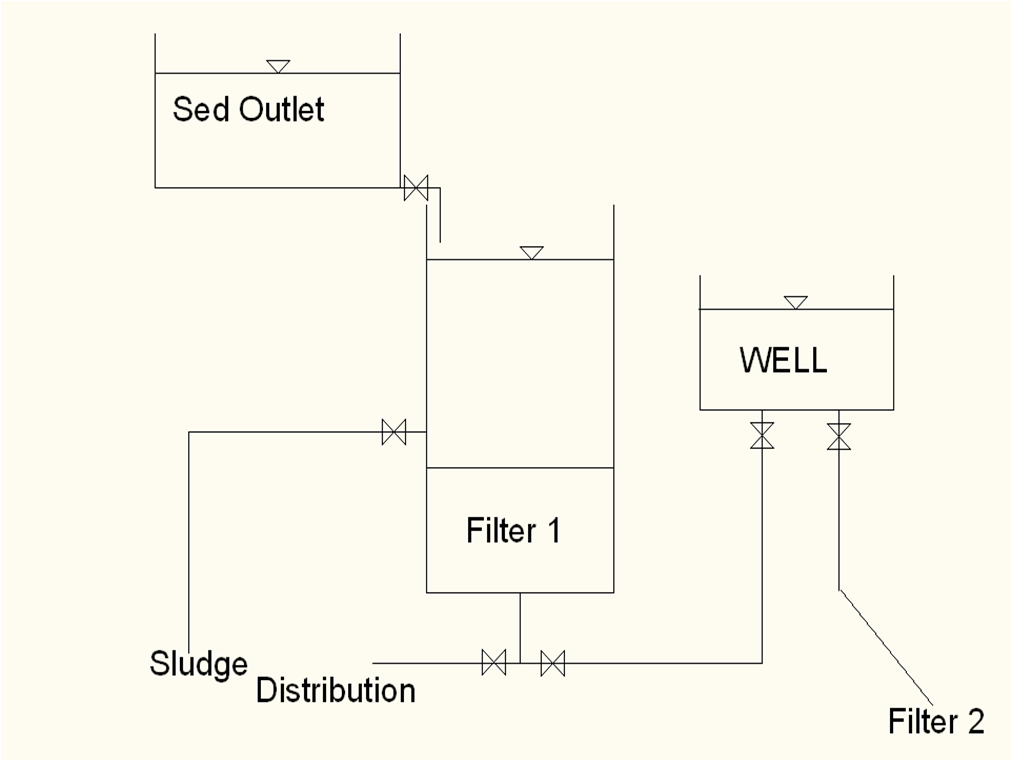
Figure 1: Clear Well Basic Concept
...