*** This version of Confluence is for testing only and contains a copy of content from June 29th 2026. No changes will be preserved. ***

...
Currently, the filtration team has made progress conducted research in three four fields: stacked filtration, clear well backwash, foam filtration, and siphon-aided backwash. Once divided up into those three sub teamsFor each subject, we each conducted a literature review of existing technology and research. We then developed initial designs based on our research and proceeded to test the fundamental theories behind our design. For example, the foam filtration sub team tested the effectiveness of foam in reducing the turbidity of the water while the clear well backwash team developed a bench scale model to test the empirical equations behind the design. Our research has led us to compile the following additional guidelines.
There are many problems requirements with conventional filtration methods , and AguaClara seeks to solve them in a sustainable waythat make them incompatible with AguaClara. This section illustrates some of those incompatibilities.
...
The goal of our research is to evaluate the feasibility of a siphon-aided backwash design to be used for a sand or mixed-media down-flow filter. The benefits of siphon-aided backwash are:
1) The height of the clear-well does not need to be equal to the the head pressure required to attain 30%-50% expansion.
2) The filter bed can be right next to the clear-well, connected via an open pipe without a valve. Flow of water into and out of the clear-well will be controlled by valves on the influent and backwash manifolds.
3) Using 55 gallon HDPE barrels, we will create a system of parallel filters surrounding a shared clear-well. By backwashing the filters out of phase, we will reduce the demand for a large clear-well. Additionally, the downflow filters will be filling the clear-well while the other filters being backwashed draw from it. This allows faster clear-well recharge rates and shortens the time between consecutive backwash cycles.
We decided to discontinue our researchi in this field because it
Currently, an AguaClara plant can produce effluent water after sedimentation with a turbidity of about 5 NTU. Our goal is to reduce the effluent turbidity to less than 1 NTU. One potential method of accomplishing this is adding a filtration unit to the AguaClara plants.
...
We based our initial design on empirical granular filtration equations from existing literature on granular filtration. A bench-scale model of our system was built and tested to observe the discrepancy between the actual and the calculated fluidization velocity required to achieve a target bed expansion. We noted an increasing difference between those two sets of values that prompted us to hypothesize that, if we were to base our design on these empirical equations, we need to implement a significant safety factor. Further experiments are needed before we can conclude whether or not our design is feasible.
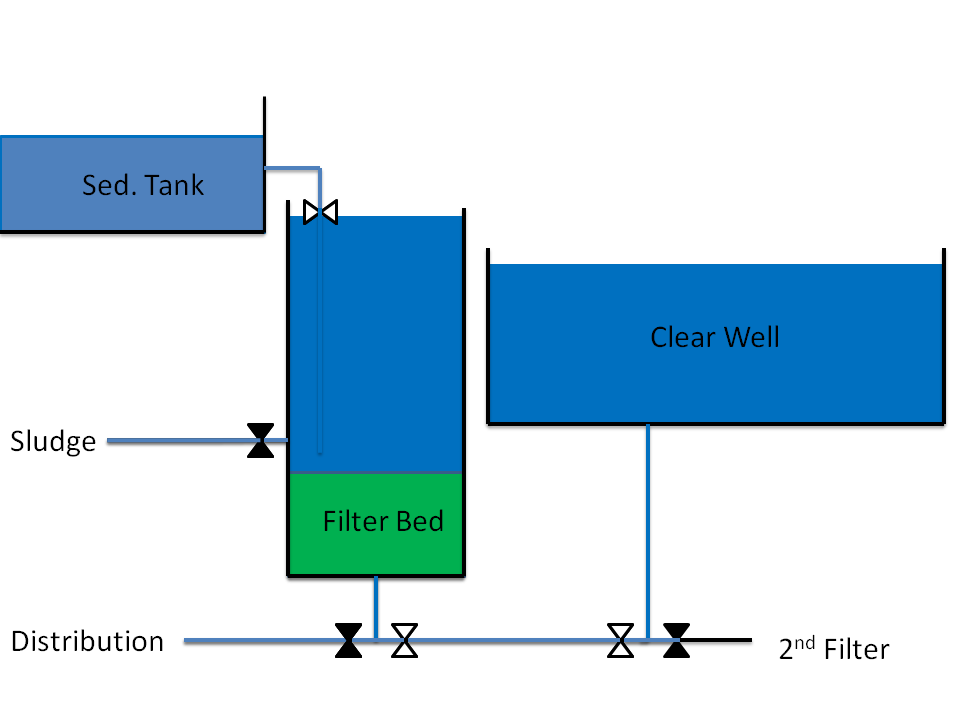
Figure 1: Clear Well Filtration Design
...
...
...
Preliminary experimental results suggest that 90 ppi (pores per inch) outperforms the larger pore size foam of 60 ppi. Our team will further test the filtration performance of the 90 ppi foam with aid of alum coagulant and rapid mix. To accomplish this, an alum dosing and rapid mix unit will be added to our experimental setup. Additionally, we would like to further test the effects of higher flow rates on the percentage of colloid removal, and mechanisms of failure of the filter foam.
See presentations given by past design teams.