*** This version of Confluence is for testing only and contains a copy of content from June 29th 2026. No changes will be preserved. ***

...
Residual Turbidity Analysis
Results from 5 NTU experiments:
Both of our replicates (Fig. 1) for a flocculator of 2796cm showed close agreement. Starting at a residual turbidity close to 5 NTU with an alum dose of 10mg/L, the residual turbidity dropped with increased alum dose until it appears to hit a limiting value of about 0.8 NTU with an alum dose of 50 mg/L. After this point, increasing alum dose no longer appears to have an effect on residual turbidity. We hypothesize that initially, floc buildup is the dominiant process occurring. However, as the flocs grow in size, shearing forces increase causing the flocs to breakup. Eventually this breakup balances the floc growth due to alum. As a result, flocs cannot continue to grow larger, and as a consequence residual turbidity stops decreasing.
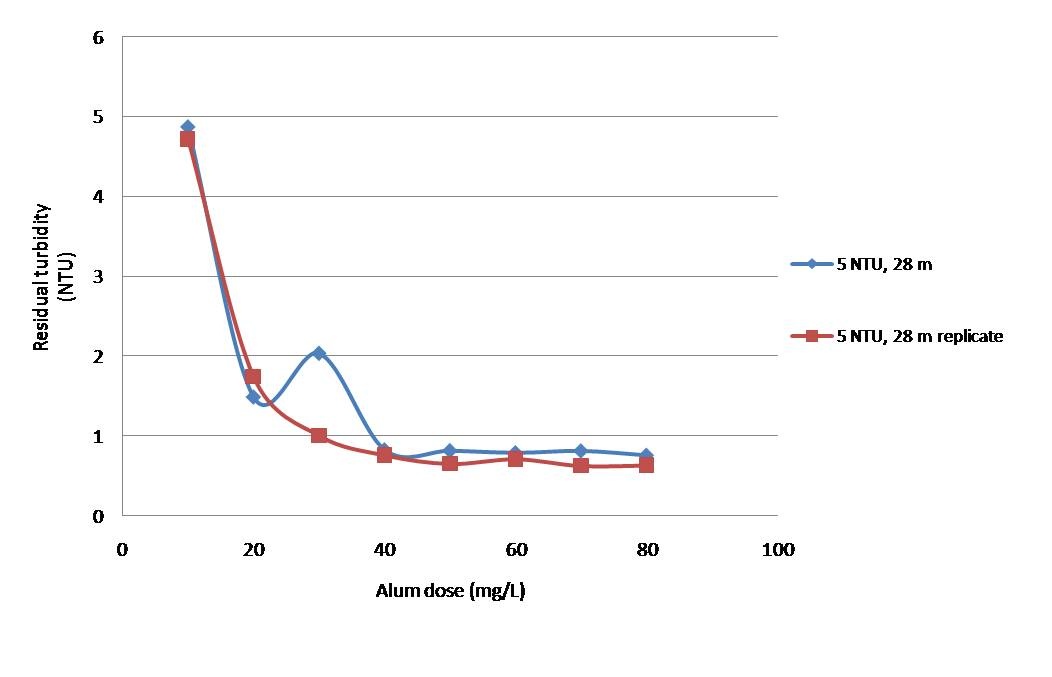
Figure 1: Residual turbidity vs. alum dose for 5 NTU influent water for a flocculator length of 2796cm.
...