*** This version of Confluence is for testing only and contains a copy of content from June 29th 2026. No changes will be preserved. ***

...
*Results from 5 NTU experiments:
Both of our replicates (Fig. 1) for a flocculator of 2796cm showed close agreement. Starting at a residual turbidity close to 5 NTU with an alum dose of 10mg/L, the residual turbidity dropped with increased alum dose until it appears to hit a limiting value of about 0.8 NTU with an alum dose of 50 mg/L. After this point, increasing alum dose no longer appears to have an effect on residual turbidity. We hypothesize that initially, floc buildup is the dominiant process occurring. However, as the flocs grow in size, shearing forces increase causing the flocs to breakup. Eventually this breakup balances the floc growth due to alum. As a result, flocs cannot continue to grow larger, and as a consequence residual turbidity stops decreasing.
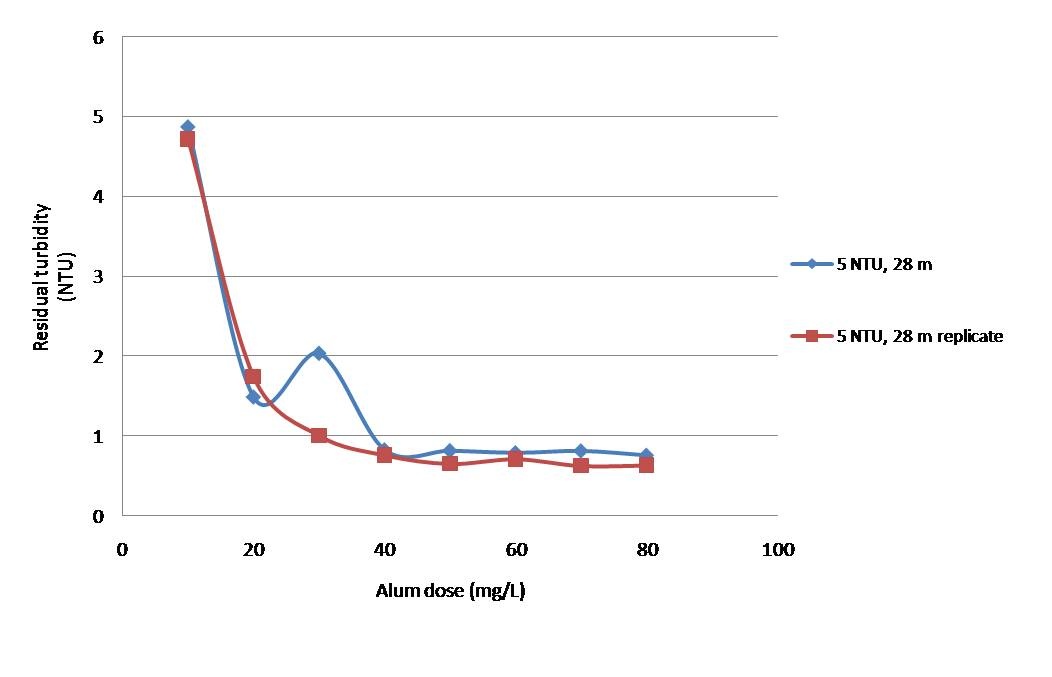
Figure 1: \ _Residual turbidity vs. alum dose for 5 NTU influent water for a flocculator length of 2796cm._
For a flocculator length of 8388cm, we focused on the lower alum dosages to see how then residual turbidity plot developed; experiments with higher alum dosages tended to show relatively constant residual turbidities around the minimum value achieved with low dosages (Fig.2). Here we a similar trend to what was observed at 2796 cm, although the two replicates do not match as closely at the low end. We suspect this is due to limits in the calibration of the pumps, combined with the possibility of blockages in the alum line and variations in influent turbidity, making it difficult to achieve consistent results at such low alum dosages.
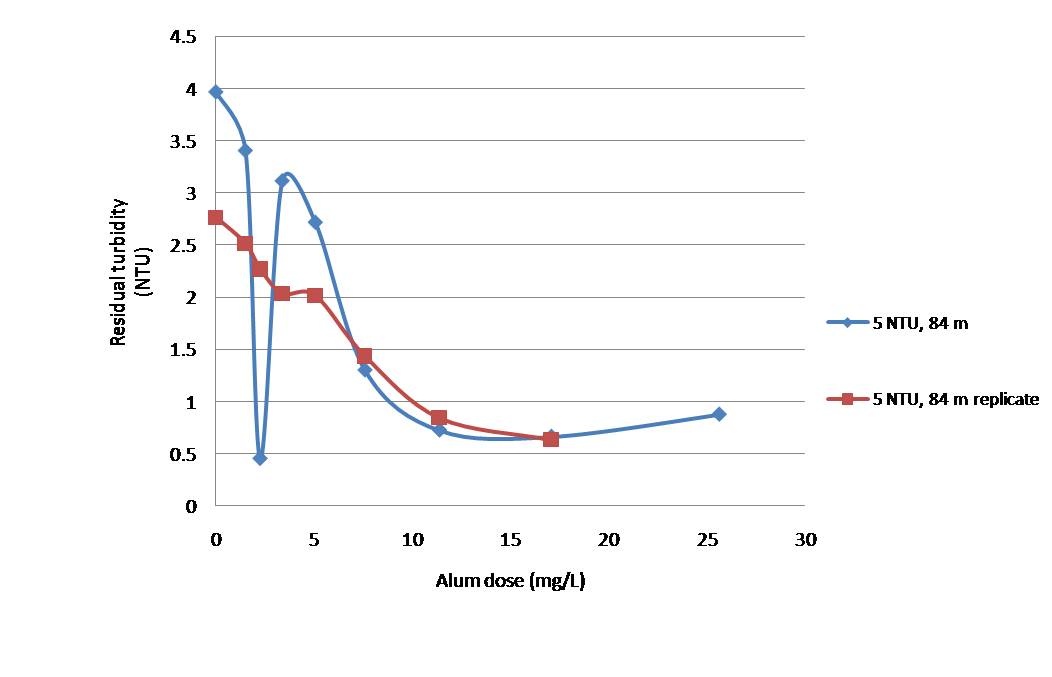
Figure 2: \ _Residual turbidity vs. alum dose for 5 NTU influent water for a flocculator length of 8388cm, focusing on lower alum dosages._
It appears that both flocculator lengths achieve similar minimum residual turbidity values of around 0.7 NTU (Fig. 3). However, the longer flocculator is able to achieve this with much lower alum dosages than the shorter one. Since shear rate was held constant, we hypothesize that the increased residence time of the longer flocculator allowed the flocs to grow larger with less alum since they had more time to collide before reaching the settling column. Although the minimum residual turbidity was achieved with lower alum dosages in the longer flocculator, it appears that increasing the length of the flocculator did not result in a lower residual turbidity than could otherwise have been achieved with the shorter flocculator using higher alum dosages.
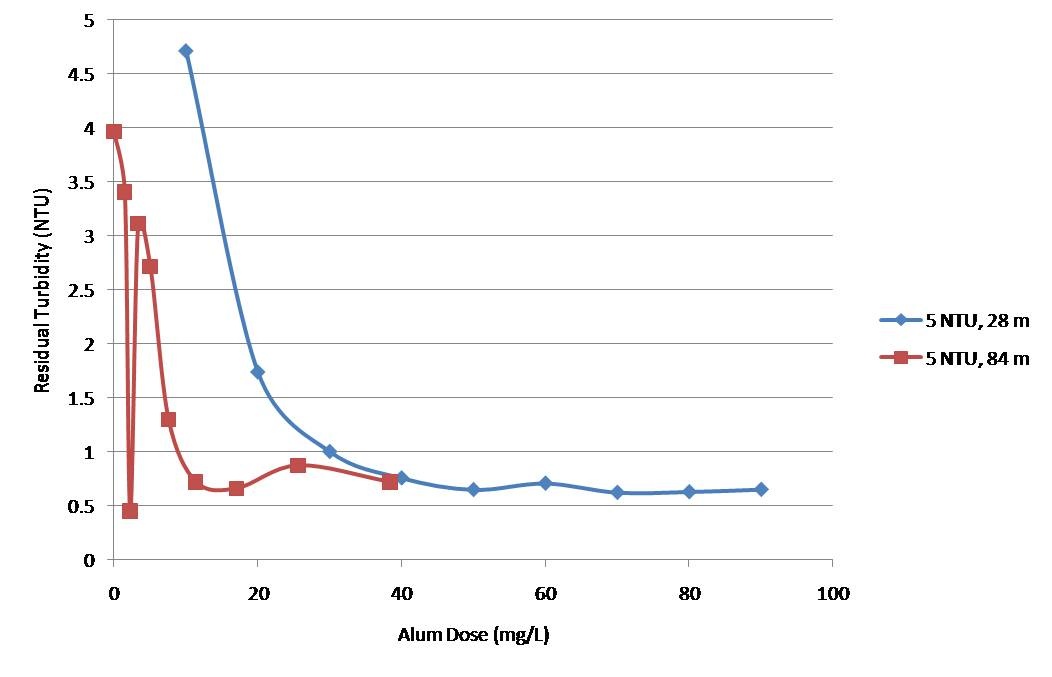
Figure 3: \ _Comparison of residual turbidity vs. alum dose for two different flocculator lengths of 2796cm and 8388cm.\ _
Results from 100 NTU experiments: 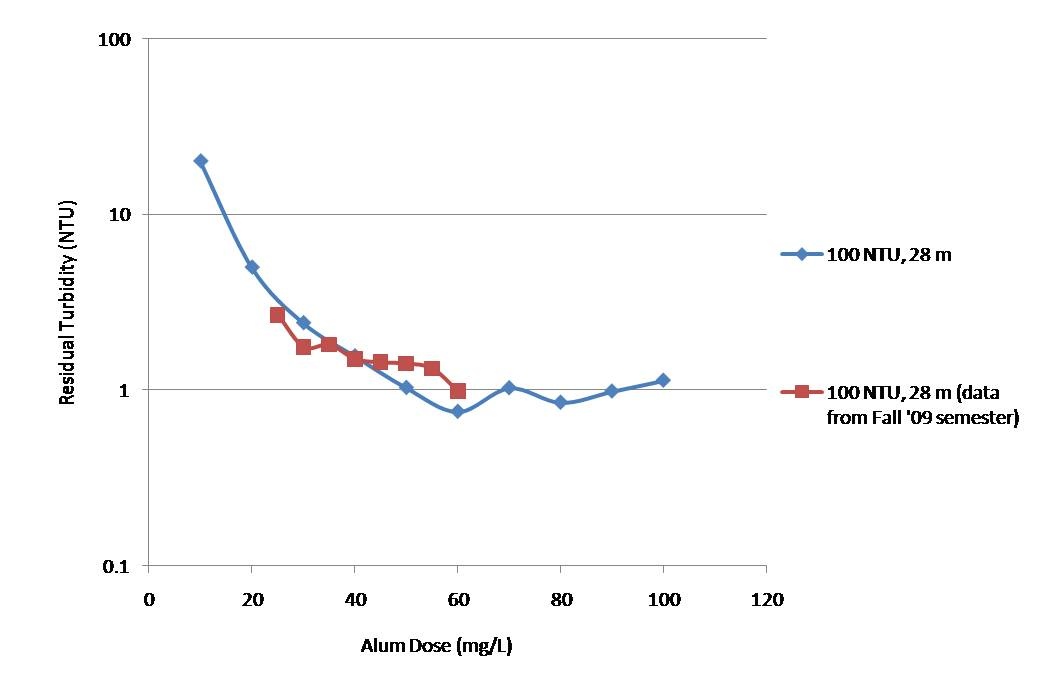
With 100NTU water and a flocculator length of 2796cm, we see a similar behavior to what was observed with 5 NTU influent water (Fig. 4). The residual turbidity starts out high before approaching a minimum value. However, this minimum residual turbidity is higher than what was observed with 5 NTU water, being around 0.9-1 NTU.
Figure 4: \ _Residual turbidity vs. alum dose for 100 NTU influent water for a flocculator length of 2796cm. A logarithmic scale is used on the residual turbidity axis to show details of the minimum residual turbidity achieved.\ _
Both replicates at 5592cm (Fig. 5) show the characteristic decay of residual turbidity to a limiting value. However, they do not agree at the low alum dosages; the second repliucate shows a much lower residual turbidty for comparable alum doses at the low end of the curve. We suspect that there may have been a blockage in the alum line during the first experiment resulting in this irregularity. This is because alum doses as high as 20 mg/L produced a residual turbidity of around 80 NTU, much higher than would be expected. We then hypothesize that the blockage cleared by the fourth data point in the second replicate, and as a result both replicates achieved similar limiting residual turbidities of around 0.8 NTU.
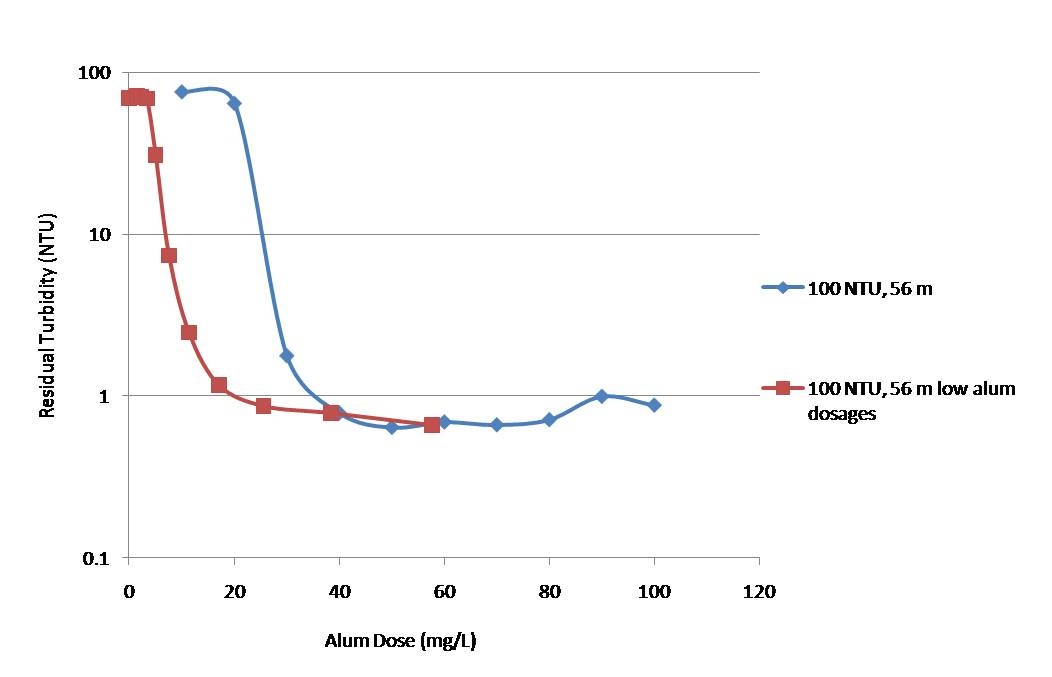
Figure 5: \ _Residual turbidity vs. alum dose for 100 NTU influent water for a flocculator length of 5592cm. A logarithmic scale is used on the residual turbidity axis to show details of the minimum residual turbidity achieved.\ _
The three replicates of a flocculator length of 8388 cm at 100 NTU show reasonable agreement, as well as the same characteristic decay of residual turbidity observed in previous experiments (Fig. 6). However, the minimum residual turbidity achieved averaged around 1.6-2 NTU, significantly higher than observed at the previous two lengths. It appears that for a flocculator length of 8388cm, the floc breakup behavior becomes more dominant, resulting in elevated residual turbdities.
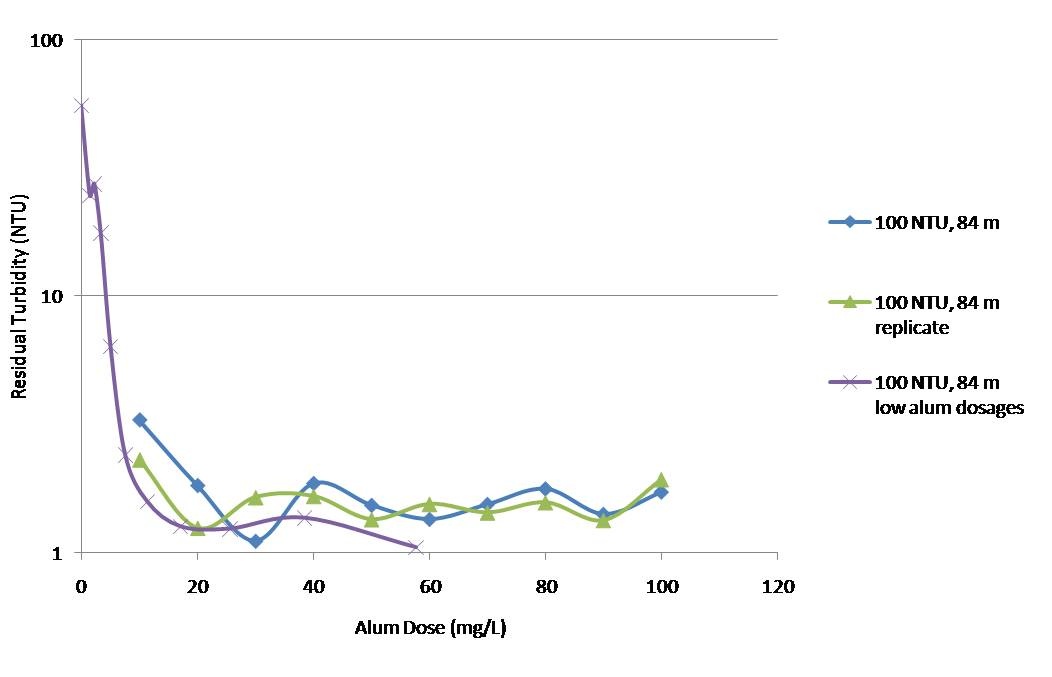
Figure 6: \ _Residual turbidity vs. alum dose for 100 NTU influent water for a flocculator length of 5592cm. A logarithmic scale is used on the residual turbidity axis to show details of the minimum residual turbidity achieved._
Comparing characteristic replicates from each of the three flocculator lengths, the same trend as seen with 5 NTU influent water is observed (Fig. 7). The longer the flocculator, the lower the alum dose needed to achieve the minimum residual turbidity. However, when the flocculator is increased from 2796cm to 5592cm, the minimum residual turbidity decreases slightly from about 0.9 NTU to about 0.8 NTU. However, when it is further increased to 8388cm, the residual turbidity jumps up to around 1.8 NTU. Therefore, it appears that while increasing flocculator length can produce favorable results as seen in the decrease in alum dose needed to achieve similar residual when comparing the two shorter lengths, further increases can be detrimental to flocculation performance. This implies that increasing flocculator length too much causes the flocs to breakup and reform smaller flocs that do not settle out as effectively.
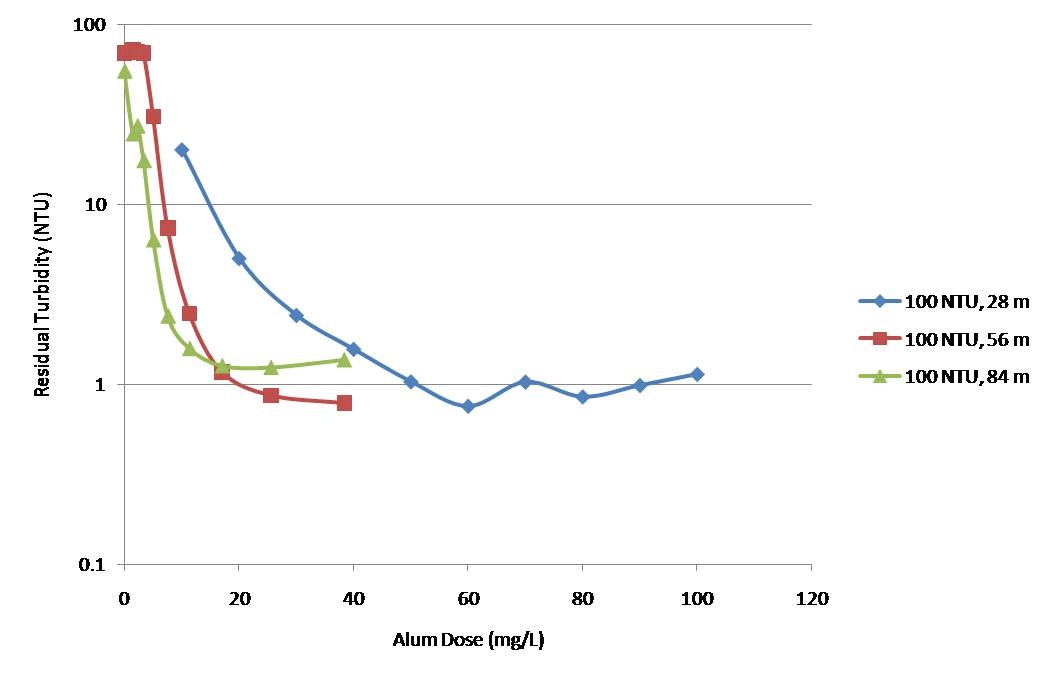
Figure 7: \ _Comparison of residual turbidity vs. alum dose for three different flocculator lengths of 2796cm, 5592cm, and 8388cm with influent water at 100 NTU. A logarithmic scale is used on the residual turbidity axis to show details of the minimum residual turbidity achieved._
Results from 500 NTU experiments:
For the 500 NTU experiments, similar minimal residual turbidities were achieved using flocculator lengths of 2796cm and 8388cm of around 2 NTU. Additionally both showed similar behaviors to what was observed before. It is unclear if the 5592cm flocculator achieved its minimum residual turbidity faster than the 2796cm flocculator since it is bounded on both sides by a 2796cm replicate (Fig. 8). Further data is needed to draw conclusions regarding how flocculator length impacts residual turbidity with 500 NTU water.
The following results are from the experiments conducted with varying influent turbidity and flocculator length.
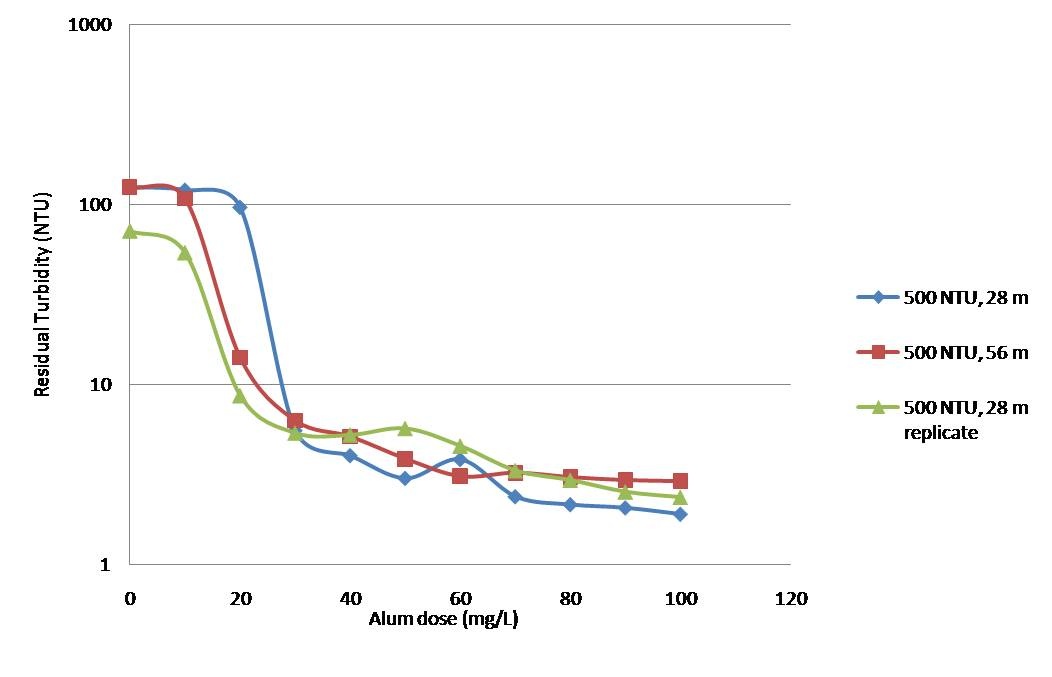
Figure 8: Comparison of residual turbidity vs. alum dose for two different flocculator lengths of 2796cm and 5592cm with influent water at 500 NTU.Mean sedimentation velocitiesMean sedimentation velocities have a different evolution when increasing alum dose depending on the influent turbidity of the raw water (100 NTU and 500 NTU in the case of the experiments).
...