*** This version of Confluence is for testing only and contains a copy of content from June 29th 2026. No changes will be preserved. ***

...
When the filter becomes clogged with dirt and needs to be cleaned, the plant operator will shut off the flow entering the filter and allow the remaining water drain out. Next, the clear well valve is opened and the backwash water from the clear well will backwash the filter bed. This water fluidizes sand particles in the filter, loosening the dirt particles caught in the sand carries away the dirt particles into the backwash pipe. The backwash pipe will be at such an elevation so that the larger and heavier sand particles will remain in the sand filter. The sand bed will expand around 30% for optimal cleaning. Once finished, the operator will close the backwash valve and begin filtration again or recharge the clear well. 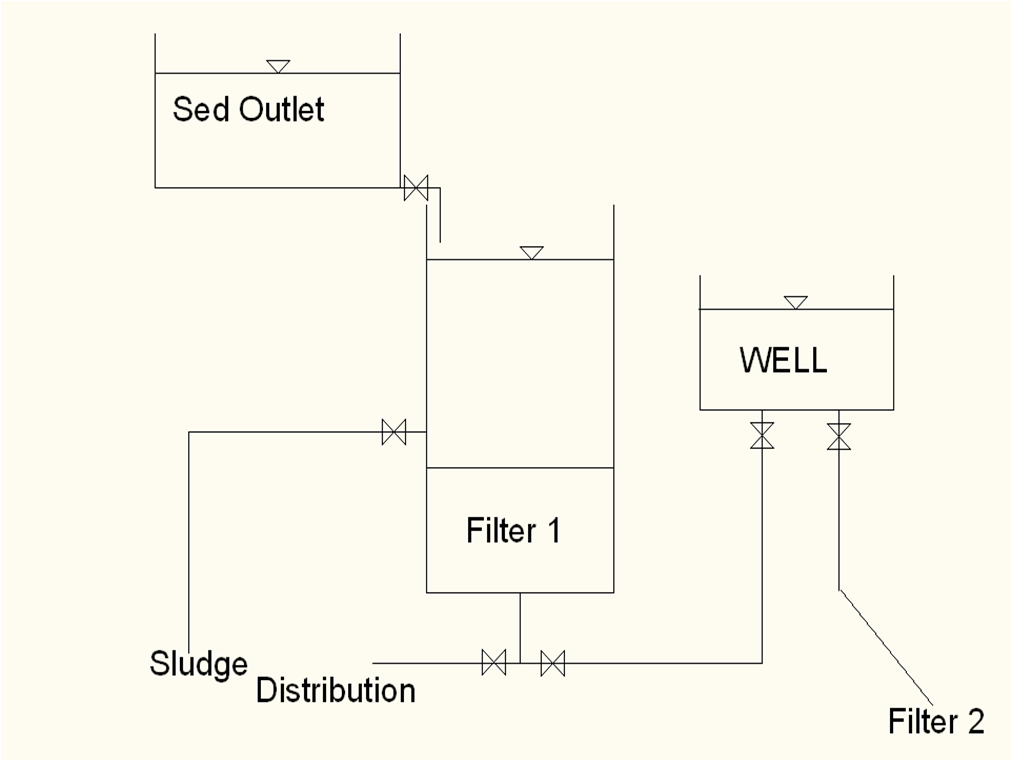
Figure 1: Clear Well Basic Concept
1) Review of existing filtration/backwash technology and research
We conducted a literature and online review. We determined the flow rate needed to sufficiently expand and clean the sand filter bed. This will help us determine how high the clear well needs to be above the filter, how large the flow pipes should be, and how much water should be in the clear well.
Research of Existing Work.
...
MathCad Results: Empirical vs. Simple Hydraulics (Conservative) Approach
Wiki Markup
| Wiki Markup |
|---|
2) The design based on the empirical Weber equation (instead of the conservative approach) is smaller and less expensive *\[ how small\]*. However, the validity of the empirical equations is not yet certain. Therefore testing needs to be done in bench and pilot scale models. \\ |
...
We had mixed results with regards to Weber's equation for filter bed expansion. At low levels of filter bed expansion, the Weber equation accurately predicted the fluidization velocity required to achieve the targeted bed expansion. As the target bed expansion increased, so did the degree of error. At 9% expansion, the degree of error was at 14%. At 38% expansion, the degree of error was at 37%. \
...
Human error:
Despite our best attempt at being consistent (by measuring and marking heights on the test tube, while also holding a ruler on the test tube wall), there will always be human error in observing the bed expansion visually.
Fix:The next expansion experiment should use a camera so there is record of the heights at each flow rate, and also tape a ruler to the filtration bed wall, rather than holding the ruler or drawing it on.
...