*** This version of Confluence is for testing only and contains a copy of content from June 29th 2026. No changes will be preserved. ***

...
Primary Reflector Parabola (Side View)
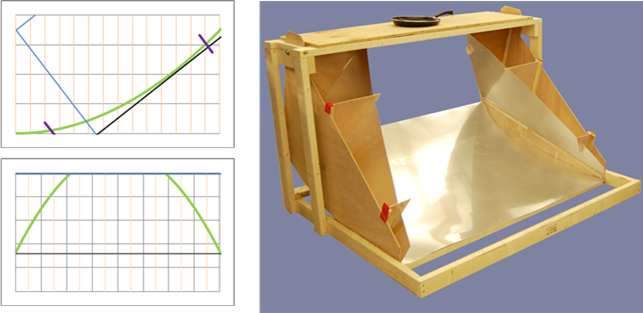
Secondary Reflector Parabola (Front View)
...
The solar elevation angle is the angle formed between the sun and the horizon. Thus, the solar elevation is 0o at sunrise or sunset and 90owhen the sun is directly overhead such that objects do not cast a shadow. It is often denoted as qΘS and can be calculated using Equation 1:

Where: qS = solar elevation angle
h = hour angle, in the local sidereal time
d = current sun declination
F = local latitude
The hour angle h is an expression of solar time for a given point on earth. It is the angle through which the earth must turn in order to bring the meridian of that point directly under the sun. Thus, the hour angle is 0o at solar noon and changes by 15owith each hour of the day. The hour angle is considered negative in the AM and positive in the PM.
...
The sun declination d is the angle between the sun's rays and the plane of the earth's equator; it can be found using Equation 3:
(3)

Where: N = day of the year (number of days spent since Jan 1)
...
In designing the concentrating cooker, our team sought to ensure that the cooker would be useful for a minimum of 2 hours per day in Nicaragua. The solar angle equations given above allowed us to calculate the minimum solar angle the cooker must therefore accept in order to meet this boundary condition. The local latitude in Nicaragua is about 13o N, and we use an hour angle of ±15o in order to bound one hour before and after solar noon. Since the smallest number of useful cooking hours occurs on the shortest day of the year, we calculate solar declination d using N = 355 (corresponding to the winter solstice, December 21):
0.7739
à) = 50o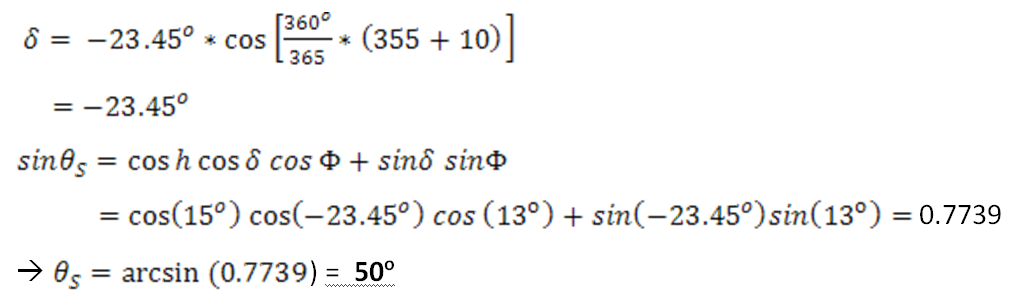
...