*** This version of Confluence is for testing only and contains a copy of content from June 29th 2026. No changes will be preserved. ***

...
The team initially examined design options that rely on a reflective parabolic dish. The geometry of a parabola takes incoming light that is parallel to its own line of symmetry and reflects the rays such that they converge on a single point in space called the focus. This focusing of sunlight can result in very high temperatures in a dark object placed at the focus. However, there were a number of issues with using a parabolic dish. In a review of existing parabolic cookers, none of the designs reviewed could be used to fry foods, as they relied on enclosed pots and/or clear plastic bags as the cooking vessel. This is related to the fact that the cooking vessel must intercept rays from many angles, unlike a flat cooking griddle that is heated from below by a wood fire. Likewise, a parabolic dish is somewhat awkward to use, as energy is aimed at a point hovering in space, requiring the cook to reach across the dish to reach the cooking vessel, which can create performance problems when the cook's shadow falls on the dish and blocks the sun. There are also safety concerns that users could easily burn themselves by accident if a hand strayed too close to the focus, the location of which is not visually obvious.
...
3. Ease of use - The design should be comfortable and convenient to cook on. It should be compatible with current cooking implements and cooking cooking habits. Ideally, it should be easy and intuitive to adjust for varying solar conditions.
...
This conundrum is exemplified by a comparison between Bernard's NELPA cooker and the Devos cooker. In the aerial-view schematic shown infigure 1, the simple shape of the NELPA's concentrator is only able to focus light in the Y dimension, whereas the complicated shape of the Devos' concentrator is able to focus light in both the X and Y dimensions. The NELPA is much simpler to construct, but the Devos is significantly more robust, using its wide design to intercept a larger area and yield higher power.
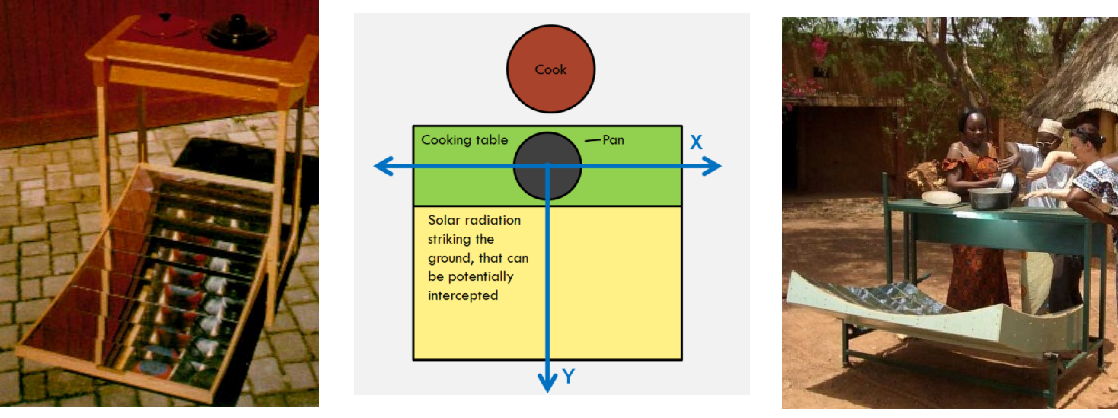
Figure 1 - Simplicity vs. Power in the Bernard (left) and Devos (right) cookers
The design created by our team, however, combines the simple geometries of the Bernard cooker with the power of the Devos cooker using a simple yet powerful concept. It features inverted, secondary reflectors that reflect sunlight after it has struck the primary reflector. The wide primary reflector focuses radiation in the Y dimension (much like the Bernard cooker), whereas the inverted secondary reflectors focus radiation in the X direction. The use of two separate concentrator geometries rather than one allows the design to simplify each reflector component, which greatly reduces the cost and complexity of construction without sacrificing the area of solar radiation that can be captured.Figure 2depicts our own design alongside graphs of the parabolic geometries at play, depicted in green. The reflectors form a single assembly that pivots like a swing to accommodate varying solar elevations.
Primary Primary Reflector Parabola (Side View)
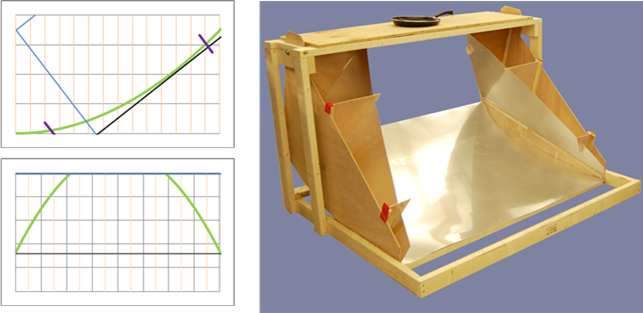
Secondary Secondary Reflector Parabola (Front View)
Figure 2 - Combining simple geometry with wide area using the secondary-reflector concept
...
The solar elevation angle is the angle formed between the sun and the horizon. Thus, the solar elevation is 0o at sunrise or sunset and 90owhen the sun is directly overhead such that objects do not cast a shadow. It is often denoted as qS and can be calculated using Equation 1: (1)

Where: qS = solar elevation angle
...