*** This version of Confluence is for testing only and contains a copy of content from June 29th 2026. No changes will be preserved. ***

...
Particle Image Velocimetry was performed on the 1-D scale-up Solar Oven at three discrete water temperatures (30o C, 50o C, and 70o C) in order to characterize how the role of convection currents changes over the heating of the oven. One way to predict and describe velocity distribution in convection cells is the dimensionless Grashof number:

Where:
B = distance between hot and cold bodies
ρ = density of fluid at mean temperature
∆T = temperature difference
β = inverse of mean temperature
g = gravitational acceleration
µ = viscosity of fluid at mean temperature
...
Due to time constraints, we were unable to alter pot quantity or placement and instead measured change of convection over varying temperature. During the experiment, we had a thermal sink of a black pot with 5 lbs. of water in the center of the oven. The field of view covered the right side of the oven from the bottom black plate to the pot on the left side. In order for the camera to be able to view inside the oven from the front, the plywood door had to be removed and a piece of glass was duct taped into place. Additionally, the back of the oven is covered with reflective sheet metal. This had to be covered with a piece of cardboard duct taped into place. We assume these changes had a negligible effect on oven performance. 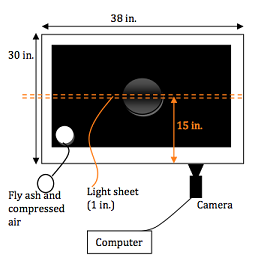
Figure 1 - PIV schematic
...
Figure 2 - Picture of PIV setup in DeFrees lab.
...
An image size of 600 x 800 pixels was used as that was the default output of the camera. An image capture rate of 30 Hz was used because it non-redundantly captured particle movements on the order of 1-3 pixels between image pairs.
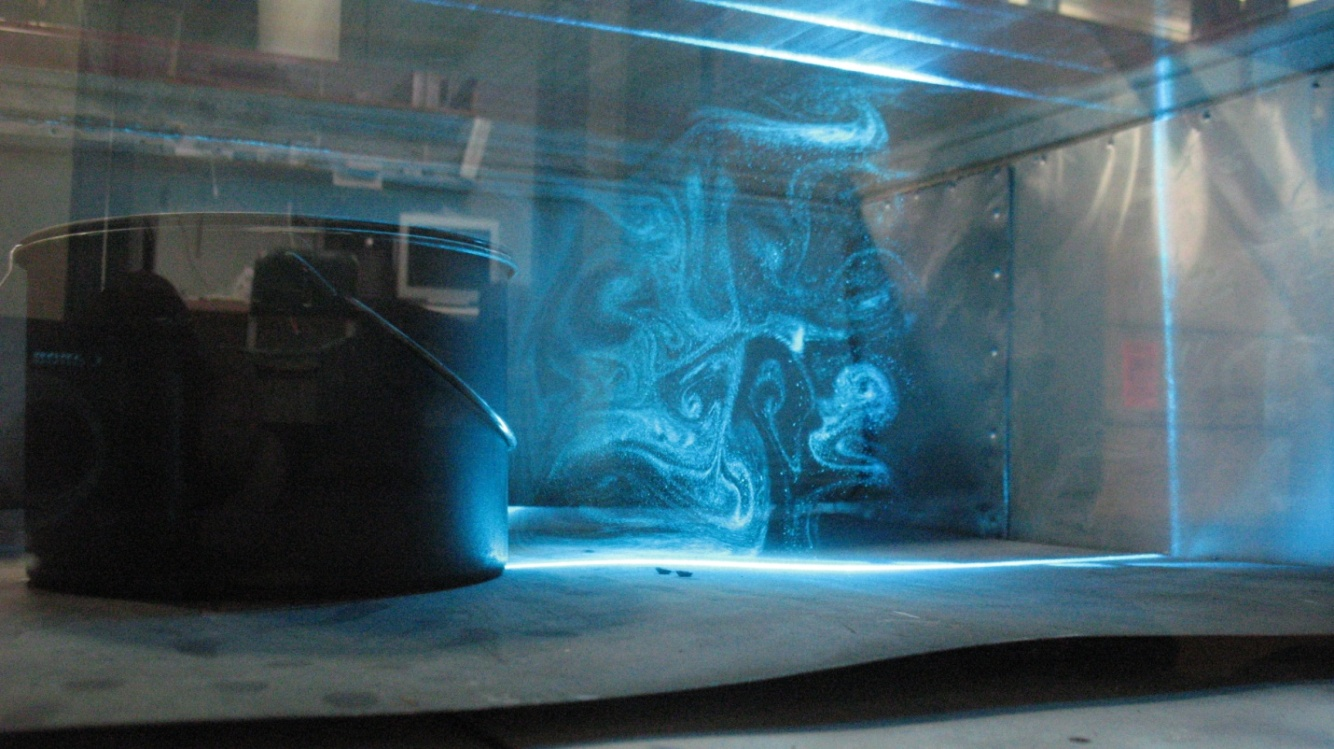
Figure 4 - Front view of PIV experiment being run.
...