*** This version of Confluence is for testing only and contains a copy of content from June 29th 2026. No changes will be preserved. ***

...
...
...
...
...
Recently,
...
the
...
Nicaraguan
...
women
...
have
...
requested
...
a
...
larger
...
oven
...
so
...
that
...
they
...
can
...
cook
...
in
...
larger
...
pots
...
and
...
make
...
larger
...
quantities
...
of
...
food.
...
This request,
...
in
...
essence,
...
is
...
a
...
desire
...
for
...
greater
...
cooking
...
efficiency,
...
an
...
issue
...
that
...
has
...
been
...
around
...
in
...
one
...
form
...
or
...
another
...
from
...
the
...
inception
...
of
...
the
...
solar
...
oven
...
project.
...
Accordingly,
...
the
...
solar
...
oven
...
team
...
decided
...
to
...
test
...
different
...
means
...
of
...
cooking
...
with
...
the
...
box
...
oven.
...
We
...
investigated
...
cooking
...
in
...
parallel
...
(multiple
...
pots
...
simultaneously)
...
as
...
well
...
as
...
in
...
series
...
(pots
...
in
...
sequence).
...
The
...
team
...
also
...
chose
...
to
...
investigate
...
the
...
issue
...
of
...
heat
...
leakage
...
through
...
the
...
door,
...
a
...
problem
...
the
...
solar
...
oven
...
team
...
noticed
...
during
...
its
...
testing
...
this
...
semester.
...
While
...
the
...
women
...
of
...
Nicaragua
...
have
...
not
...
explicitly
...
mentioned
...
this
...
issue,
...
it
...
directly
...
relates
...
to
...
cooking
...
efficiency
...
and
...
thus
...
merits
...
investigation.
...
The
...
solar
...
oven
...
team
...
hopes
...
that
...
our
...
findings
...
will
...
help
...
empower
...
the
...
women
...
of
...
Nicaragua
...
to
...
cook
...
more
...
food
...
in
...
a
...
shorter
...
amount
...
of
...
time.
...
Black pots and their caps were weighed on a scale and the weights were recorded to four decimal places. The cap of the pot was removed and the scale was then tared. Three pounds of water were poured into the pot. The weight of the water in the pot was recorded to four decimal places. The pots were covered and placed in solar oven, with their placement in the solar oven recorded.
Thermocouples were placed inside the oven touching the plate, inside the oven not touching the plate (inside air), and inside the pots in the middle of the pot about half way down the water depth. A thermocouple was also placed outside the oven to record outside air. Once the thermocouples were placed, the solar lights were turned on. During the first experiment, it was noted that two lights were out. To keep the experiment consistent, these lights or lights in similar positions remained off the entire experiment.
The pots were left in the solar oven until the water inside the pot reached a temperature of 100°C. The pots were removed from the solar oven and weighed on the scale. The total weight of the pot, cap, and water was recorded to see if there was any significant water loss. A total of four parallel cooking experiments were conducted: 1 pot, 2 pots, 3 pots, and 4 pots. See figure 1below for pot configurations and lighting arrangement.
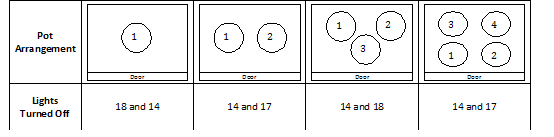
Figure 1 - Pot Configuration and Lighting for Parallel Cooking Tests
A similar experiment was conducted to collect data regarding cooking pots in series. The same procedure as testing pots in parallel was used. However, instead of cooking up to four pots at one time, pots were split into multiple cooking times. For example, to cook two pots of water, one pot was placed in the oven until it reached 100°C, removed, and replaced with second pot filled in three pounds of water. A total of two experiments were run in series: 1 pot followed by 1 pot & 2 pots followed by 2 pots. See figure 2 below for pot placement and light arrangement.
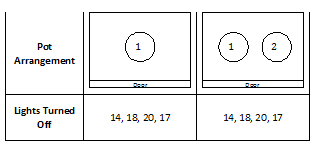
Figure 2 - Pot Configuration and Lighting for Series Cooking Tests
To compare the cook time of 3 lbs of water with a new door installed on the solar oven, the same procedure as testing pots in parallel with 1 pot was used. For pot configuration and lighting arrangement see figure 3 below.
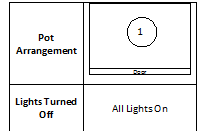
Figure 3 - Pot Configuration and Lighting for New Door Test
We performed four different tests to evaluate the effects of water mass on cooking speed in the solar cooker. We varied the test by adding an additional 3-lb of water filled pot to each successive test. Figure 4 below shows the plots of temperature vs. time for the four parallel cooking tests. While the boiling time increased with water mass, the increase was not a direct relationship. The time to boil four pots of water (12 lbs) was far less than four times the amount of time to boil 1 pot of water (3 lbs).
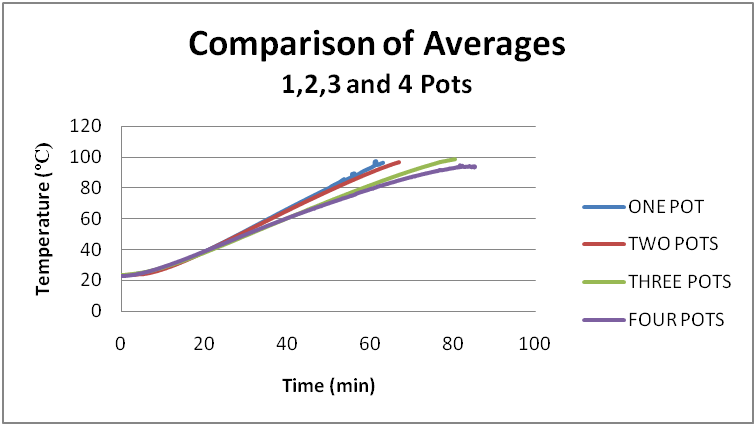
Figure 4 - Boiling time (minutes) vs. average water temperature (°C) for parallel cooking tests.
To further examine the difference in temperature verses time, figure 5 shows the different temperatures after 60 minutes of cooking in the form of a bar graph. The data shows that the difference between 1 and 2 pots of water is somewhat small---a difference of 3.3%. However, the drop in temperature increases somewhat drastically from 2 pots to 3 pots, after 60 minutes of cooking. It is important to note that this drop, nevertheless, is not a decrease in time per unit thermal mass of water. The data shows conclusively that the greater the thermal mass of water heated in parallel the greater the efficiency.
Figure 5--The difference in temperature reached after 60 minutes of cooking during the parallel heating tests.
Another comparison we implemented was the difference in time it took each pot to reach 95°Celsius (figure 6). Again, it is clear to see that the difference between 1 pot and 2 pots is relatively small, and then there is a jump between 2 and 3 pots. Also, the data collected for the 4 pot test, on average, never reached 95 degrees Celsius.
Wiki Markup Figure 6 - The time (minutes) that it took the average temperature in the pots for each test to reach 95°C. \[The average data collected for the 4 pot test never reached 95°C, hence it's absence in this bar graph.\]
...
An
...
important
...
note
...
is
...
that
...
the
...
temperature
...
in
...
3
...
out
...
of
...
4
...
of
...
the
...
pots
...
for
...
the
...
4
...
pot
...
test
...
reached
...
95
...
degrees.
...
After
...
80.6
...
minutes,
...
3
...
pots
...
were
...
at
...
95
...
degrees
...
or
...
hotter.
...
However,
...
there
...
was
...
one
...
pot
...
that
...
remained
...
below
...
75
...
degrees
...
for
...
the
...
entire
...
testing
...
period.
...
Using the
...
data
...
from
...
this
...
pot
...
in
...
the
...
average
...
for
...
the
...
4
...
pot
...
test
...
drastically
...
reduced
...
the
...
average
...
temperature
...
for
...
the
...
test.
...
It
...
is
...
tempting
...
to
...
blame
...
the
...
low
...
temperatures
...
on
...
a
...
misreading
...
of
...
the
...
thermocouple
...
or
...
a
...
mistake
...
in
...
the
...
set-up
...
of
...
the
...
system.
...
However,
...
we
...
determined
...
that
...
the
...
thermocouple
...
was
...
not
...
broken
...
or
...
msitaken
...
but
...
rather
...
that
...
the
...
temperature
...
in
...
the
...
pot
...
must
...
have
...
actually
...
been
...
less
...
than
...
the
...
temperature
...
in
...
the
...
other
...
3.
...
This
...
led
...
us
...
to
...
re-examine
...
the
...
set
...
up
...
of
...
the
...
solar
...
cooker.
...
The pot
...
in
...
question
...
was
...
located
...
at
...
the
...
front
...
left-hand-side
...
of
...
the
...
cooker
...
as
...
shown
...
in
...
figure
...
7
...
below.
...
Consulting
...
our
...
lighting
...
set
...
up,
...
we
...
noted
...
that
...
there
...
are
...
several
...
lights
...
that
...
are
...
burnt
...
out
...
on
...
the
...
left
...
side
...
of
...
the
...
cooker.
...
We
...
also
...
noted
...
that
...
this
...
particular
...
pot
...
was
...
near
...
the
...
door
...
and
...
the
...
door
...
eventually
...
had
...
to
...
be
...
fixed
...
due
...
to
...
bowing
...
of
...
the
...
wood.
...
Both
...
of
...
these
...
issues
...
could
...
have
...
influenced
...
the
...
lower
...
temperature
...
of
...
the
...
water
...
in
...
the
...
front,
...
left
...
pot.
...
Front
...
of
...
Oven
Figure 7.
...
Visual
...
depiction
...
of
...
weaker
...
lighting
...
zone
The series testing did not prove to be more efficient than the parallel testing. Heating 2 pots of 3 lbs of water to 95⁰C in series took 32% longer (86 minutes) than heating 2 pots of 3 lbs of water simultaneously. Similarly, heating 4 pots of 3 lbs of water to 95⁰C in series took 40% longer (112 minutes) than heating the 4 pots simultaneously. Therefore, based upon observations with up to 12 lbs of water, cooking in series is much more time consuming than cooking in parallel. The Solar Oven Group does not recommend that the women of Nicaragua cook in series if cooking in parallel is an option.
Approximately one month into testing, a gap between the oven door and the body of the oven was discovered and predicted to be a significant source of heat loss that need not be overlooked. After attaching a wood stiffener "seal" to the oven door, the 1 pot- 3lbs test was repeated to investigate the effect of the anticipated heat loss on the oven's performance.
As shown in figure 8, the addition of the wood seal to the solar oven door did not have a significant impact on the overall temperature performance of the oven.
Figure 8 - Comparison of performance for the solar oven before and after the addition of the wood door seal.
The time it took the oven to reach 95⁰C decreased from 61.1 minutes for the old door to 59.4 minutes for the new door for an overall difference of 2.6% (figure 9). After 60 minutes, the solar oven with the new door was 2.8% hotter compared to the old door.
The Solar Oven Group concluded that the performance improvement of the oven with the new door was small enough that the data collected for the 2 pot-3lbs, 3 pot-3lbs, and 4 pot-3lbs tests was accurate enough for the purposes of the group's analysis.
Figure 9 - Comparison of times required for solar oven to reach 95⁰C before and after the addition of the wood door seal.
While the Solar Oven Group determined that cooking in parallel was the most efficient method of cooking, the group did not explore the maximum capacity that the oven could handle without being "overloaded". This could be a noteworthy topic to investigate in coming semesters.