*** This version of Confluence is for testing only and contains a copy of content from June 29th 2026. No changes will be preserved. ***

...
The rapid mix system is designed to accomplish this. The rapid mix design consists of piping leading from the entrance tank to the flocculator entrance. The piping contains two orifices. The orifices decrease the cross sectional area of the flow allowing for a higher velocity and thus turbulence. Turbulence, measured in energy dissipation rate, is associated with the formation of eddies which mix the alum to the length scale at which viscosity overrides the formation of eddies with a larger energy dissipation rate being associated with a smaller eddies. The length scale at which the eddies can mix the alum to is known as the Kolmogorov length scale.
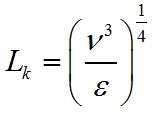
Where:
L.k: Kolmogorov Length Scale
...
In the current design, we have two circular orifices on the same pipe segment. Originally, the micro-mixing orifice was after the first pipe bend. However we have decided to change that to allow facility of removal when cleaning is required. The micro-mixing orifice is two pipe diameters below the macro-mixing orifice. This ensures adequate mixing time for macro-mixing to take effect. The orifices for both equations are sized using the equations of minor loss coefficient for a submerged orifice.
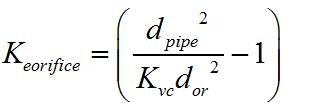
Where:
K.e.orifice: Minor loss Coefficient
K.vc: Vena Contracta Coefficient
d.pipe: Pipe Inner Diameter
d.orifice: Orifice Diameter
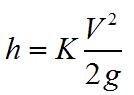
The equation for head loss is shown below:
...
Figure 2: Rapid mix sizing algorithm for lower flow rates with 20 cm through micro-mixer and no constraints
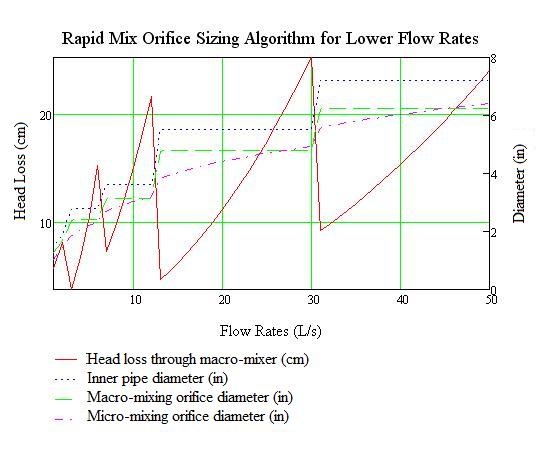
The results show that above that with each pipe size and macro-mixing size, we have high head losses through the macro-mixing orifice which will increase to levels greater than 20 cm and hence give most of the head loss through the micro-mixing orifice.
The algorithm can be summarized in these following steps:
1. Determine the inner pipe size given the flow-rates, maximum pressure drop (20 to 50 cm). total minor loss coefficients, and the available pipe sizes. The user also sets a constraint or limit for the macro-mixing orifice head loss.
...