*** This version of Confluence is for testing only and contains a copy of content from June 29th 2026. No changes will be preserved. ***

...
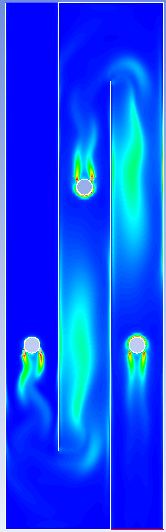
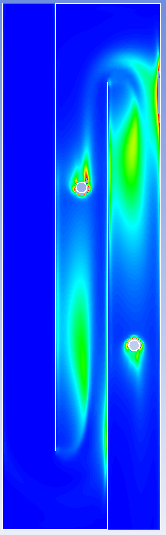
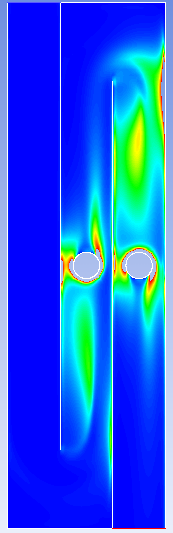
Time step intervals (scale is .01 m^2/s^3)
After seeing the effects of the position of the shapes on the energy dissipation of the flow, having an obstruction before the first turn decreases the energy dissipation zone after the first turn and through other turns too. Also having a circle before the first turn is more expensive because the changing flow shedding points on the circle is constantly fed by the input uniform turbulent flow in the simulation causing the time variance to persist for the entire simulation. If the first circle is placed after the first turn, the time variance disappears after a couple of time steps. This may also show that there is a correlation between the amount turbulent kinetic energy dissipation generated at the first instant the incoming flow is disturbed and the turbulent kinetic energy dissipation achieved at later points in the flow. The more turbulent kinetic energy dissipation generated at the first disturbance of the incoming flow, the more turbulent kinetic energy dissipation is achieved further inside of the flocculator.
The generation of an energy dissipation zone can be imagined as a nozzle ejecting flow. A smaller nozzle ejects disturbances that decay faster than a larger nozzle. In turbulence, larger eddies last longer than smaller eddies, and a larger nozzle creates larger eddies. A larger flow spacing (nozzle) for the obstructions may create a larger energy dissipation zone (that compares with the energy dissipation zone after a turn in the flocculator). The next step is evaluating having half of the circle on either side of the wall at some position instead of the circle obstructing the center of the channel.