*** This version of Confluence is for testing only and contains a copy of content from June 29th 2026. No changes will be preserved. ***

The experimental setup we use to analyze flocculator performance is known as the Flocculator Residual Turbidity Analyzer (FReTA). Figure 1 shows the first section of the plantsetup. It contains the raw water, alum, and clay stock buckets, as well as the pumps and influent turbidimeter. The raw water turbidity is controlled using a feedback loop on Process Controller. The influent turbidimeter is constantly monitoring the raw water stock turbidity since raw water is pumped to the influent turbidimeter by the turbidimeter pump in a loop which returns it to the stock bucket. If the turbidity drops below the desired value, the clay stock valve opens for one second every ten seconds until the desired turbidity is reached. The turbidity will dilute down as the plant runs.
...
Figure 3: New tubing added to increase flocculator length
The final portion of FReTA is the settling column and effluent turbidity shown in Figure 4. After steady state flocs have been achieved, (we usually allow 1.5 -2 residence times to ensure a steady state floc distribution) the pumps shut down slowly, and the ball valve shown in Figure 4 seals off the settling column from the rest of the flocculator. The effluent turbidimeter then measures the turbidity every second for half an hour as the flocs settle out. This data is recorded by the computer, and used in the data analysis step to determine settling velocities, particle size distributions, and residual turbidity.
Figure 4: Settling column and effluent turbidimeter.
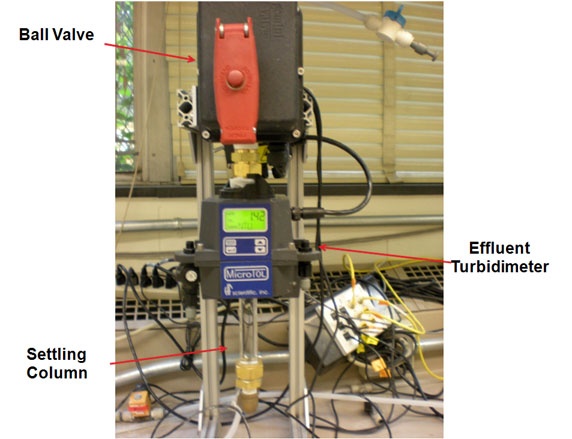
Figure 5 shows the entire setup.
Figure 5: The entire FReTA setupFigure 4: Whole Setup