*** This version of Confluence is for testing only and contains a copy of content from June 29th 2026. No changes will be preserved. ***

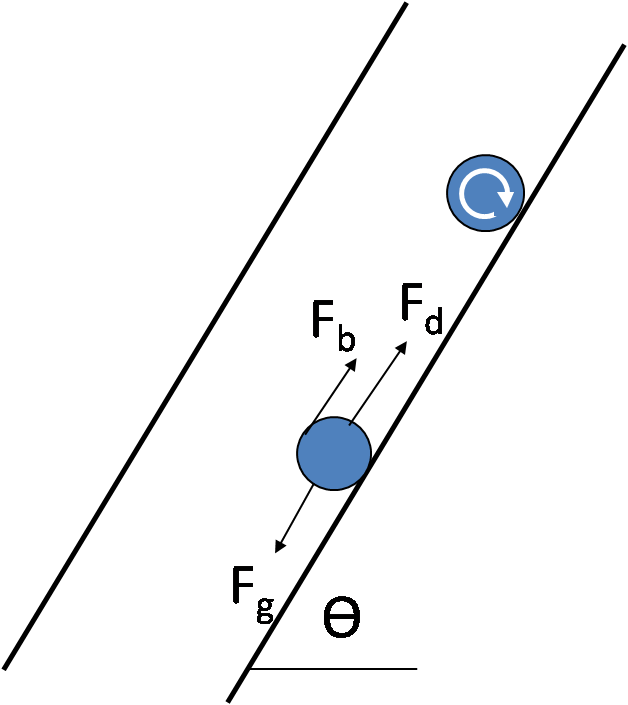
Our The Plate Settler Spacing team is currently running experiments to investigate investigating the phenomenon of 'floc-rollup' through floc roll up in the tube settler which occurs when the drag and buoyant forces acting on a floc particle exceed the force of gravity. We have been working on different ways to model this physical situation (in most cases based on a force balance), and hope to eventually obtain data that agrees with one of our theoretical predictions. Through developing a model and running various experiments, we hope to both analytically and experimentall determine the critical velocity floc particles experience when they begin to roll up the settler tube and into the effluent.
When an incompressible fluid flows through a cylindrical tube its velocity relative to the walls changes as a function of the tube radius. In general, this velocity distribution is parabolic: the greatest velocities are achieved at the center of the tube (where R=0) eventually tapering off to 0 at the walls. The parabolic nature of the distribution arises from cylindrical symmetry as well as the fact that the fluid does not move at the walls (the "no-slip" condition).
This gradient in the velocity profile contributes to the force that a floc experiencing roll-up feels. Flocs actually begin to roll up when the velocity at their edge exposed to the flow exceeds some critical value, which is highly dependent on the floc's diameter, its density, and the capture velocity of the system, among other thingsTo show evidence of floc-rollup occurring in the tube settler, we have been setting up experiments in which the apparatus was subjected to a ramped volumetric rate, (flow through the settler was increased linearly over the duration of the experiment). Once good data has been collected, we hope to be able to graph effluent turbidity against time and identify a "spike" in turbidity that corresponds to the threshold flow rate at which roll-up starts to occur. This observed threshold flow rate will be compared to that determined from all of our different predictions, and thus may help us determine which physical model is most appropriate for our system. We plan to perform these experiments and clearly identify threshold flow rates for all available tube settler diameters.
...